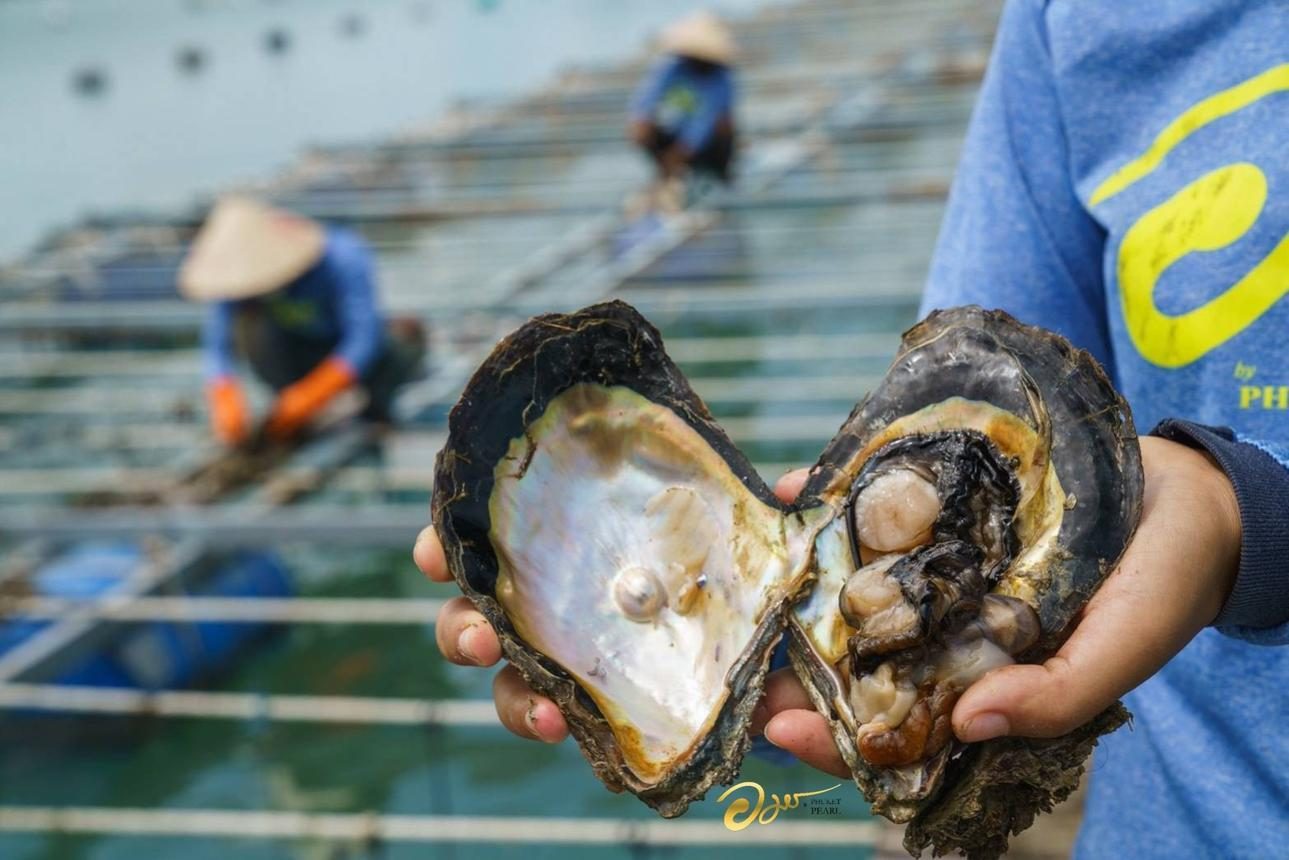
Behind a pearl’s smooth surface lies a process that is slow, uncertain, and often unforgiving.
Inside the brutal process behind something so delicate
Softness, built through resistance
Few materials appear as effortless as pearls. They are associated with softness, restraint, and a kind of quiet refinement that feels almost untouched by process. Their surface reflects light gently, without the sharp brilliance of gemstones, and their presence is often described as natural, even inevitable.
But nothing about a pearl is effortless. Behind its smooth surface lies a process that is slow, uncertain, and often unforgiving, one that begins not with perfection, but with irritation, and unfolds over years with no guarantee of success. To understand what it takes to find a pearl worth wearing is to understand how much is required before beauty becomes visible.
The beginning: disruption, not design
Unlike gemstones that are mined, pearls are formed within living organisms. The process begins when an irritant is introduced into a mollusk, typically an oyster or mussel. In natural conditions, this irritant might be accidental, a grain of sand or a parasite. In cultivated pearl farming, it is deliberately placed, a small nucleus inserted with precision into the soft tissue.

What follows is not immediate transformation, but response. The mollusk begins to secrete layers of nacre around the irritant, coating it gradually over time. This is not a controlled or predictable process. It is biological, reactive, and dependent on conditions that are difficult to regulate.
Temperature, water quality, and even subtle environmental changes can alter the outcome. Many oysters do not survive the process. Many that do, produce pearls that are unusable. The beginning, therefore, is not about creation but about survival.
Time as a material
A pearl cannot be rushed. Depending on the type, it may take anywhere from several months to several years for a pearl to develop. During this time, the mollusk continues to deposit nacre in microscopic layers, building the surface that will eventually define its appearance.

This accumulation is what gives pearls their characteristic luster, a depth that is not achieved through polishing, but through time. And yet, time alone is not enough. Too little nacre results in a dull surface, too much irregularity disrupts symmetry, and too many environmental variables can compromise the structure entirely. The process demands patience, but offers no certainty.
The reality of yield
For every pearl that reaches the standard required for fine jewelry, many do not. After harvesting, pearls are sorted according to: luster, surface quality, shape, size, and color. The majority fall short of what is considered wearable in a high-quality context. They may be too irregular, too dull, or too marked by surface imperfections.

This is where the process reveals its brutality. What appears abundant is, in reality, selective. What reaches the market as a finished piece represents only a fraction of what was produced. The rest is discarded, repurposed, or reduced in value.
Luster: the defining quality
Among all the factors that determine a pearl’s worth, luster is the most critical. It is not simply shine, but the quality of light reflected from the surface and through the layers of nacre. High-quality pearls exhibit a sharp, almost mirror-like reflection, combined with a sense of depth that appears to come from within.
This is what distinguishes a pearl that feels alive from one that appears flat. Luster cannot be added after formation. It is the direct result of conditions, time, and biological response. It is, in many ways, the most honest indicator of quality.
Shape and the question of perfection
For much of modern history, the ideal pearl was perfectly round. Symmetry was equated with value, and irregular forms were often considered secondary. But this perspective has begun to shift.
Baroque pearls, with their asymmetrical and often unpredictable shapes, are increasingly appreciated for their individuality. Rather than being defined by deviation, they are valued for variation. This does not mean that perfection has lost its place. It means that the definition of perfection has expanded.
Color as nuance
Pearls exist in a range of colors, from classic white and cream to gold, silver, and deep, almost iridescent tones. Unlike gemstones, where color can be uniform and saturated, pearl color is often layered and subtle, influenced by both the type of mollusk and the environment in which it was cultivated. Overtones (secondary hues that appear on the surface) add further complexity, creating variation even within similar shades.

This nuance is part of what makes pearls difficult to standardize. No two are exactly alike.
From ocean to object
Only after selection does a pearl begin its transition into jewelry. It is drilled, matched, and arranged, often with other pearls that share similar qualities, a process that requires both precision and restraint. Even at this stage, decisions must be made about how the pearl will be presented, how it will move, and how it will interact with the body.

The final piece may appear simple. But simplicity, in this case, is the result of extensive filtration. The Modi Pearls collection shows what survives that filtration.
A pearl’s value is not defined by its softness, but by what it has endured to achieve it. Behind every surface that appears smooth and effortless lies a process shaped by time, uncertainty, and selection. What is ultimately worn is not only the result of natural formation, but of elimination, a refinement of what remains after countless variables have been resolved. This is what makes a pearl worth wearing. Not that it is perfect, but that it has become so despite everything required to form it.
Related reading: The return of pearls, but not the way you expect and Pearls were never just pretty. They were political.



 Line
Line
 WhatsApp