How South Asia shaped the meaning of one of the world’s oldest gems
Let’s try a quick experiment: ask a stranger to describe a pearl. Chances are, they’ll say shiny, pretty, maybe a round bead from a distant sea. But until the mid-20th century in Hyderabad, it was something else entirely. It was a sentence in a language everyone at court understood, beyond anything verbal.
The Currency of Power
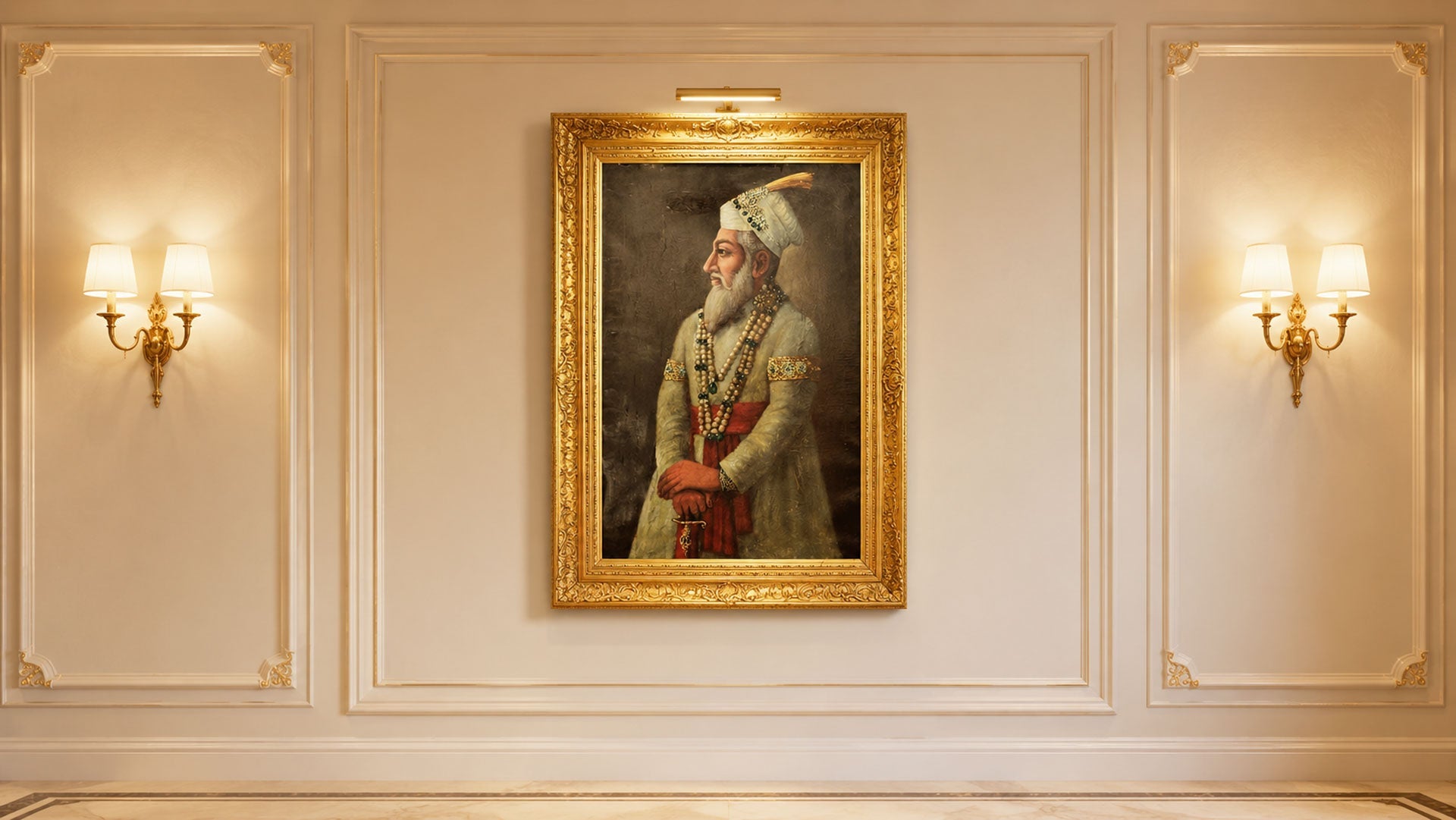
Picture the scene: a foreign envoy steps into the Nizam’s audience hall, the air heavy with attar and expectation. The room is a careful study in light and shadow. Marble floors, high ceilings, carved stones. At the far end…the Nizam himself appears with long strands of pearls layered over his sherwani, pearls edging his turban, and even along the hilt of his sword.

(Image : Old photograph of the Nizam wearing a set of pearl necklace, credited to the museum : THE CITY MUSEUM | The Nizams Museum)
Pearls in Hyderabad formed a kind of complex hierarchy. In the bustling bazaars, they were traded like any other luxury commodity. Measured, graded, and negotiated. But within palace life, they weren’t treated as mere adornments, they were a kind of currency in an unwritten political economy.
The Threads of Honor and Blessing
Consider the marriage negotiations of elite families. A pearl necklace chosen as part of dowry was rather calibrated. The number of strands you have represents respect and wealth. And the ideal “satlada” with seven strands and authentically 465 pearls could signal how seriously a bride’s family took the match, how much they were willing to invest in the alliance, and how they wanted their daughter to be read when she entered her new home. Seven strands didn’t simply mean more pearls (well, they are more pearls, but that’s besides the point); they whispered continuity, fertility, and an unbroken line of prosperity that both families wanted.
Once inside the new household, those same pearls still continued to talk. A satlada brought out for festivals and formal gatherings reminded everyone of the promises agreed and power exchanged between families. Pearls could outlast tempers and negotiations. They sat patiently in silk‑lined boxes, waiting to be brought out when the room needed a reminder of who had given what, and when.
The Unspoken Words
The Nizams were masters of this language. Under their rule, pearls became part of the official vocabulary of rule and favor. A visiting dignitary might leave Hyderabad with more than warm memories. He might receive a carefully chosen strand of pearls, a pair of earrings, well-decorated bangles, or a brooch. On the surface, it was a generous gift. Beneath that, it was a marker: you have been recognized and folded into the intimate circle of the Deccan court.
Records from the colonial period hint at how eagerly such pieces were sought. British merchants and officials navigating the delicate balance between empire and princely states knew that Hyderabadi pearls played very well in London drawing rooms. A gift from the Nizam (worn at the right dinner, before the right audience) could say far more about one’s influence and connections than any official posting.
Even within the court, pearls ranked people. A sherwani embroidered with pearls down the front or studded along the collar was not something any courtier could casually commission. The placement, number, and prominence of pearls on clothing created a spectrum of authority visible at a glance. In an age before digital profiles and tagged photos (or post collaborator), this was how you knew who mattered.
The Beads of Devotion
And then there were the contradictions. In religious life, especially during Muharram processions, pearls were sewn into banners and standards carried through the streets as offerings of devotion. They glowed bright under harsh sun, visible to ordinary citizens who might never step inside palace halls. On those days, pearls performed an entirely different role. It is no longer about status, but about sacrifice and remembrance. Yet even here, politics lingered very subtly in the background. A ruler’s choice to sponsor lavish adornment for religious processions also spoke to his piety and his claim to moral authority.
The Basra Pearls that turned a Landlock City, “The City of Pearls”
Behind all of this, global networks hummed. Basra pearls arrived earlier in Hyderabad than in many other Indian cities, thanks to the Nizams’ direct relationships with Arab traders. Those alliances weren’t just about securing superior gems, but rather about positioning Hyderabad as a node of international commerce. A place where materials, money, and influence collided. When these Gulf pearls were later set with Golconda diamonds or Colombian emeralds, the resulting jewels became miniature maps of the Nizam’s power and reach.
Over time, as political winds shifted and the old order fractured, the meaning of these pearls changed, but no one could ever say they became neutral. When the flow of Basra pearls slowed, the last few natural strands that had once been part of everyday court life transformed almost overnight into relics. Families guarded them as evidence of “what we once were,” a kind of portable archive of status.

Today, when a Hyderabadi pearl jewelry appears in an auction catalog or a museum exhibition, it’s presented under bright lights and crisp captions. But you can still sense the subtext. Behind every label – “natural Basra pearls” or “Asaf Jahi period” and so on – there is a story embedded in every bead about rivalries, alliances, negotiations, and rooms where decisions were made while pearls shifted softly against silk.
So, no, in Hyderabad, pearls were never just shiny, pretty, beads from a distant sea. They were how rulers displayed power, how families measured commitment, how a city announced its place in the world.





 Line
Line
 WhatsApp