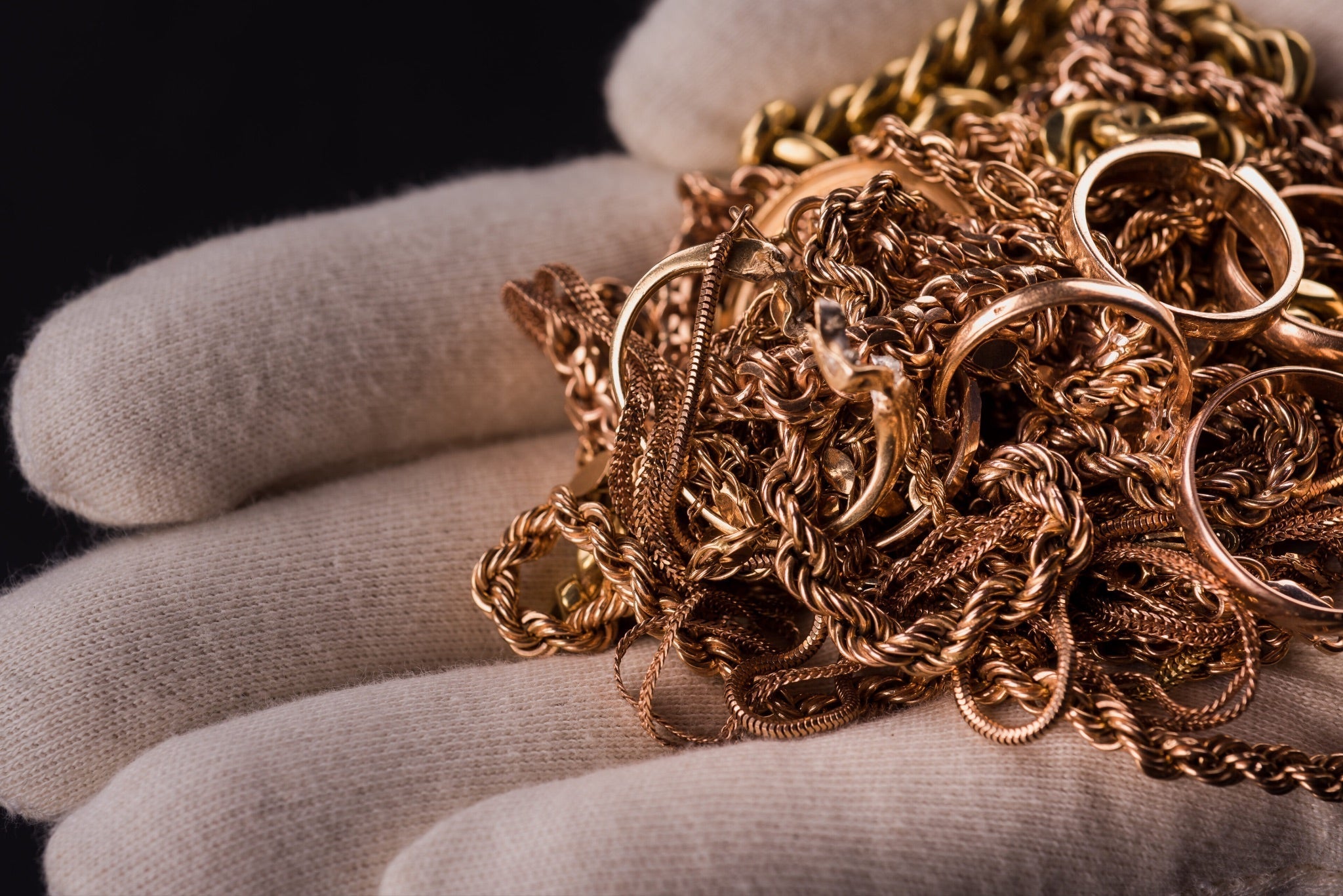
Gold plating, disposable pieces, and what gets thrown away
The shift from permanence to replacement
Jewelry was not always designed to be replaced. Historically, it was made to endure, crafted from materials that could withstand time, repaired when damaged, and often passed from one person to another. Even the smallest pieces carried an expectation of continuity, existing within a longer lifecycle that extended beyond a single moment of use.
That expectation has shifted. As fashion cycles have accelerated, jewelry has followed. Pieces are now produced, purchased, and discarded at a pace that mirrors clothing trends, where relevance is temporary and replacement is anticipated. What was once considered lasting has, in many cases, become disposable.
The change is not always immediately visible, but it is structural.

The illusion of gold
One of the clearest indicators of this shift lies in the widespread use of gold plating. At a glance, plated jewelry resembles solid gold. It carries the same color, the same visual warmth, and often the same design language. But beneath the surface, the material is fundamentally different. A thin layer of gold is applied over a base metal, creating the appearance of value without its durability.
Over time, that layer wears away. Contact with skin, exposure to moisture, and daily friction gradually erode the surface, revealing the material beneath. The piece that once appeared refined begins to fade, discolor, or lose its original finish entirely. This is not a defect, it is an expectation built into the design.

Designed for a shorter life
Unlike traditional jewelry, which is often constructed with longevity in mind, many fast-produced pieces are designed around a shorter lifespan. Chains are thinner, clasps are lighter, and materials are selected for cost efficiency rather than durability. The result is jewelry that fulfills its purpose temporarily: long enough to align with a trend, but not necessarily long enough to endure beyond it.
When these pieces break or deteriorate, they are rarely repaired. They are replaced. This shift from maintenance to disposal alters not only how jewelry is used, but how it is valued.
The accumulation of waste
What is discarded individually accumulates collectively. Jewelry, particularly when made from mixed or low-cost materials, is difficult to recycle. Plated metals, synthetic components, and adhesives complicate the process, making large-scale recovery inefficient. As a result, many pieces end up as waste, stored, forgotten, or eventually discarded.
Unlike garments, which visibly degrade, jewelry often remains intact even after it is no longer worn. It lingers, accumulating in drawers or entering waste streams where it persists without purpose. The damage, in this case, is not immediate. It is cumulative.
The speed of trend versus the pace of material
Fashion trends now move at a pace that materials were never designed to follow. Jewelry, even in its simplest form, requires extraction, processing, and production. These are not inherently fast processes. Yet the demand for constant novelty has compressed timelines, creating a mismatch between how quickly pieces are produced and how long they are intended to last.
A design may be relevant for a season, or even a few weeks, before it is replaced by another. In this cycle, durability becomes secondary, and what matters is immediacy.

The perception of value
Fast fashion jewelry has reshaped how value is perceived. When multiple pieces can be purchased for the price of one, the idea of investing in a single, long-lasting item becomes less intuitive. Variety replaces longevity, and quantity becomes a substitute for durability. But this shift raises a question.
If a piece is replaced repeatedly, is it truly less expensive?
The cost is distributed differently, across time, across purchases, and often across materials that do not retain their value beyond use.
What gets lost in the process
Jewelry, at its core, has traditionally been associated with continuity. It marks events, carries memory, and exists across time in a way that few other objects do. When pieces are designed to be temporary, that continuity is interrupted. The object no longer accumulates meaning because it’s exchanged before it has the chance to.
This does not mean that all contemporary jewelry must be permanent, or that change itself is a problem. But it does suggest that something shifts when the lifecycle of an object is shortened to align with trends rather than time.
Between accessibility and consequence
The accessibility of jewelry today is not without significance. It allows more people to engage with style, to experiment, and to participate in visual expression without the constraints of high cost. This expansion has value in itself.
But accessibility exists alongside consequence. Lower prices often reflect decisions made at earlier stages of production: in material selection, labor conditions, and construction methods. These decisions shape not only the object, but its lifespan and its afterlife. Understanding this relationship does not require rejecting accessibility. It requires recognizing its structure.
Fast fashion did not change what jewelry is made of. It changed how long it is expected to last. In doing so, it altered the relationship between object and time, shifting jewelry from something that endures to something that circulates: produced quickly, worn briefly, and replaced without hesitation. The damage, unlike in other forms of fashion, is not always immediately visible. It appears gradually, in what fades, in what breaks, and in what is left behind.



 Line
Line
 WhatsApp