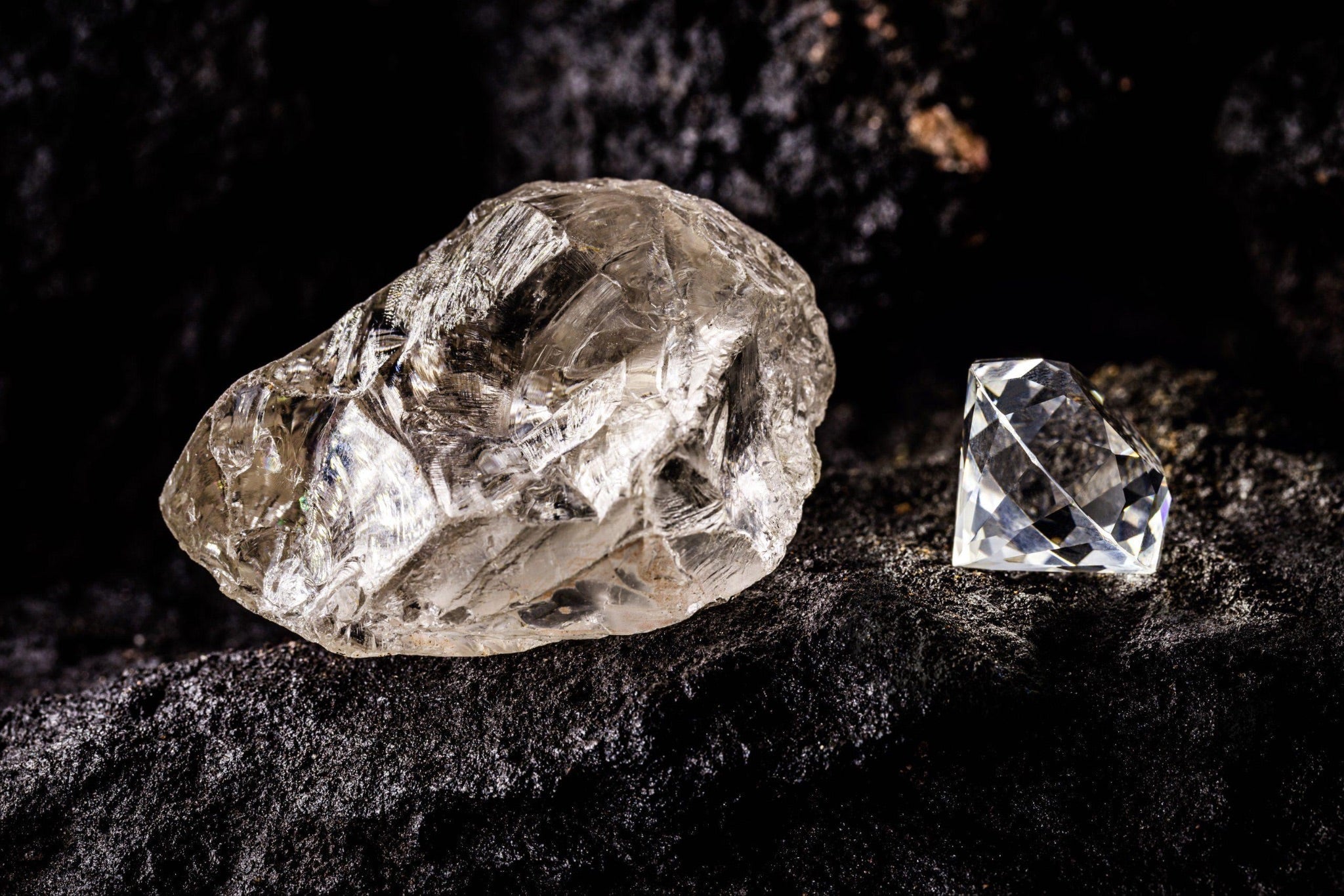
The precision behind the illusion of perfection


The myth of natural perfection
Diamonds are often described as symbols of perfection, objects that arrive fully formed, inherently brilliant, and untouched by human intervention. But in their natural state, diamonds are far from what we recognize.
Fresh from the earth, they appear opaque, irregular, and often unremarkable. Their surfaces are matte rather than reflective, their forms unrefined, their potential hidden beneath a structure that does not yet interact with light in any meaningful way. There is no immediate brilliance, no sparkle, no clarity in the way it is commonly understood.
What we perceive as perfection is not discovered, it’s constructed.
From stone to structure
The transformation of a diamond begins with analysis.
Before any cutting takes place, the stone is examined in detail, not only for its visible characteristics, but for its internal structure. Inclusions, stress points, and natural growth patterns must be understood before a single decision is made. This stage determines everything that follows.
A diamond cannot simply be shaped at will. It must be read, interpreted, and approached with an understanding of how it will respond to pressure and precision. A single miscalculation can compromise the entire stone, resulting in loss of material or structural damage. What appears effortless at the end is the result of highly controlled decision-making at the beginning.

The geometry of light
Brilliance, the quality most associated with diamonds, is not a natural attribute. It is the result of geometry. When a diamond is cut, it is divided into facets, each positioned at specific angles designed to control how light enters, reflects within the stone, and exits back toward the viewer. If these angles are too shallow or too deep, light escapes rather than returning, and the diamond appears dull.
Precision is not aesthetic, it is mathematical.
The arrangement of facets must align with exact proportions in order to maximize reflection. This is what creates the interplay of brightness, fire, and scintillation, the dynamic qualities that give a diamond its presence. Without this structure, the stone remains visually inert.
Loss as part of creation
To create brilliance, material must be removed. A significant portion of the original diamond is lost during the cutting and polishing process. What begins as a larger rough stone is gradually reduced, shaped, and refined until only the most structurally and visually effective form remains.
This reduction is not wasteful but necessary. Every facet carved into the surface represents a decision, a balance between preserving weight and achieving optimal light performance. The final diamond is not a complete version of what was found, but a selective version of what remains.
The role of the human hand
Despite advances in technology, diamond cutting remains a process that relies heavily on human expertise. Machines can assist with measurement and mapping, but the execution, the interpretation of the stone, the adjustment of angles, the control of pressure, requires experience and precision that cannot be fully automated. Each diamond presents a different set of variables. No two stones are identical and no two decisions are entirely the same.
The cutter’s role is not simply technical, but interpretive. They must balance the natural characteristics of the stone with the desired outcome, making choices that will ultimately define how the diamond is perceived. In this sense, brilliance is not only engineered, but crafted.

The illusion of effortlessness
When a diamond is finally set into jewelry, the process that shaped it becomes invisible. What remains is the illusion of effortlessness, a surface that reflects light cleanly, a form that appears balanced and complete. The complexity of its creation is no longer visible, replaced by a perception of natural perfection. This illusion is central to how diamonds are experienced.
They do not reveal the process, they conceal it, and in doing so, they reinforce the idea that brilliance is inherent, rather than constructed.
Precision as perception
The value of a diamond is often discussed in terms of measurable qualities: the 4Cs, grading scales, and technical specifications. But these measurements ultimately serve one purpose: to shape perception.
Brilliance is not only a physical phenomenon but a visual experience. It exists in the way light interacts with the stone, in the way the eye responds to that interaction, and in the way the diamond is understood within its context.
A diamond does not begin as something extraordinary. It becomes extraordinary through a process that is defined by analysis, precision, and deliberate reduction. What appears effortless is the result of countless decisions, each one shaping how the stone will interact with light and how it will ultimately be perceived. Brilliance is not found, it is made. And once it is made, it is almost impossible to see the work that created it.






 Line
Line
 WhatsApp