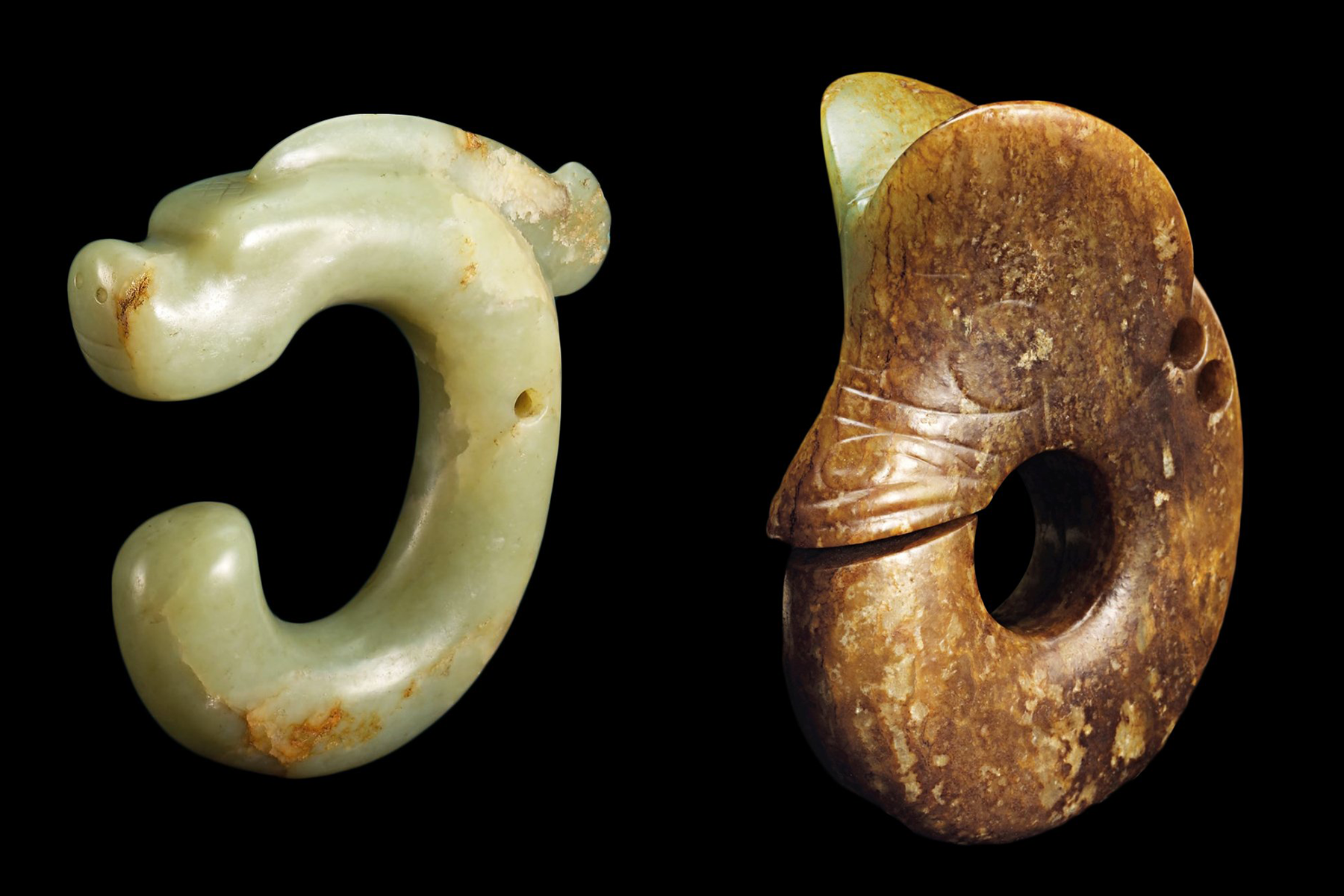
For over 2,000 years, jade has been more than just an ornament in the Chinese world — it has been a language of virtue, ceremony, and taste.
Before China entered the dynastic era (such as the Xia, Shang, and Zhou dynasties), jade was regarded as a sacred object imbued with spiritual significance rather than merely a decorative ornament. Jade was seen as the “stone of heaven,” a medium that connected the human world with the cosmos. Its beauty, durability, and strength led the ancient Chinese to regard it as a symbol of virtue, purity, and immortality.
Confucius once compared the virtue of a good person to jade : transparent, strong, yet gentle at the same time.
Pre-dynastic era : Jade was used as early as the Hongshan culture (Neolithic period, 5000–2000 BCE) in both rituals and burials, linked to the universe and funeral rites.
Hongshan Culture (ca. 5000–3000 BCE with some evidence extending to 2000 BCE)
The Hongshan Culture (紅山文化) flourished during the late Neolithic period, around 5000–3000 BCE (with some datings extending to 2000 BCE). It was located in northeastern China, particularly in Liaoning Province and Inner Mongolia.
This culture is regarded as one of the earliest in which jade played a prominent role in ritual practices and spiritual beliefs.
-
Among the earliest cultures to make extensive use of jade
-
Significant jade artifacts include bi (璧 – circular discs with central perforations), cong (琮 – square tubes with circular hollows), dragon-shaped forms (“pig-dragon”), and jade masks
-
Jade was employed in rituals, offerings, and burials, reflecting beliefs in the connection between heaven and earth and in protective spiritual powers
-
Importance : Established the symbolic concepts of jade, which were inherited by the Liangzhu culture and later dynasties
Longshan Culture (ca. 3000–1900 BCE)
Longshan Culture (龍山文化) was an ancient culture of late Neolithic China that flourished in the Yellow River valley, Central and eastern China particularly in the provinces of Shandong, Henan, and Shanxi. It is regarded as a crucial cultural bridge between Neolithic societies and the emergence of early Chinese civilization.
The Longshan Culture represents the transition from Neolithic agricultural communities to a more complex social structure, serving as the prelude to historical Chinese civilization. Some scholars believe that the Xia dynasty—the first dynasty described in Chinese tradition—was directly influenced by Longshan.
-
Renowned for thin, black “eggshell pottery”
-
Early construction of rammed-earth city walls, indicating social organization and defense against external threats
-
Jade was used to craft bracelets, amulets, and ritual objects, though in simpler forms than those of the Hongshan and Liangzhu cultures
-
Importance : Represented a transitional stage from Neolithic society toward the emergence of early states and the first dynasties of China
-
Jade was used to make bracelets, plaques, and animal-shaped pendants.
-
It played a role in ritual practices and was often buried alongside the deceased.
Liangzhu Culture (ca. 3300–2300 BCE)
Liangzhu Culture (良渚文化) was an ancient culture of late Neolithic China, centered in the lower Yangtze River valley, particularly in present-day Zhejiang Province. It is regarded as one of the most advanced cultures in East Asia during its time and is often celebrated as the earliest civilization of southern China.
The Liangzhu Culture reflects the development of a society characterized by centralized authority, organized political structures, and a sophisticated religious system. Known as the “Jade Civilization” of China, it is recognized as a foundational stage of ancient southern Chinese civilization. In 2019, UNESCO inscribed the Archaeological Ruins of Liangzhu City as a World Heritage Site, testifying to the prosperity and distinctiveness of this early civilization in the region.
-
Importance : This period witnessed the height of jade artistry prior to the dynastic age.
-
Its most significant symbols were the bi (璧 – circular discs with central perforations) and the cong (琮 – square tubes with circular hollows).
-
Archaeologists interpret the bi as representing heaven and the cong as representing earth, with jade thus directly associated with ceremonies venerating both heaven and earth.
Sources of Jade
-
Nephrite jade was obtained from regions such as Xinjiang, Henan, and Liaoning.
-
The transportation of jade across regions reflects extensive networks of trade and cultural exchange.
Symbolic Meanings
-
Rituals: Jade was used in offerings to heaven, ancestors, and deities.
-
Society and Power: Possession of numerous jade artifacts or finely carved pieces signified elite status and authority.
-
Beliefs in the Afterlife: Jade was placed in tombs to safeguard the soul and prevent the decay of the body.
Jade Disc (bi 璧)
-
Form: A flat circular disc with a central hole.
-
Meaning: Associated with the symbolism of heaven, employed in ceremonies of celestial worship and cosmology.
-
Archaeological context: Commonly found in tombs, often placed upon the body of the deceased or near the head.

Jade Tube (cong 琮)
-
Form: A square exterior with a circular hollow interior.
-
Meaning: A symbol of earth or the terrestrial realm.
-
Archaeological context: Found in ritual settings, often buried together with bi to signify the completeness of the cosmos—heaven and earth in harmony.

Zoomorphic and Divine Jade Objects
-
Dragon-shaped forms (sometimes referred to as the “pig-dragon” 困龙).
-
Masks or animal heads, used in ritual offerings and reflecting beliefs in spiritual guardianship.
Continuity into the Dynastic Age
With the rise of the Xia and Shang dynasties, jade beliefs endured and became central to the governing philosophy of Confucianism, which extolled the “virtues of jade”—such as steadfastness, benevolence, and purity. Jade thus transcended its material value to become a symbol of kingship and the divine mandate of heaven.
Xia Dynasty (ca. 2070–1600 BCE)
The Xia Dynasty is traditionally regarded as the first dynasty in Chinese history. Though its archaeological evidence remains debated, it is celebrated as the formative stage of early Chinese kingship and state power.
-
Ritual and Political Authority
Continuing traditions from the Liangzhu and Longshan cultures, jade was employed in state ceremonies and sacrificial rites, legitimizing the authority of rulers. -
Symbol of the Elite
Ritual forms such as the bi (璧) and cong (琮) persisted, symbolizing cosmic order and the bond between heaven and humanity. -
Faith and Belief
Jade was imbued with sacred power, believed to protect and mediate between the human and spiritual realms.
Jade in the Xia Dynasty represents the transition from Neolithic ritual objects to symbols of sovereignty, sacred kingship, and moral authority. This laid the foundation for the enduring Chinese ideal of jade as the emblem of virtue and legitimate rule, a concept further developed in the Zhou and later dynasties.
Shang Dynasty (ca. 1600–1046 BCE)
The Shang Dynasty marked the rise of one of China’s earliest fully developed state societies, with complex urban centers, bronze technology, and elaborate ritual systems. Royal tombs from this period—such as the famous tomb of Lady Fu Hao—have yielded abundant jade artifacts, demonstrating its central role in Shang culture.
-
Ritual Implements
Jade was carved into ceremonial forms, including bi (璧), cong (琮), and dagger-axes (ge, 戈), used in sacrificial rites and offerings to ancestors and deities. -
Funerary Objects
Jade ornaments and amulets were placed in burials of kings and nobles, symbolizing protection, divine favor, and the continuation of power in the afterlife. -
Spiritual Significance
Jade was seen as a conduit between the human and spiritual worlds. Its incorruptible quality made it the perfect medium for communicating with ancestors and gods. -
Artistic Forms
Shang jade carvings frequently depicted animals—such as dragons, birds, and tigers—imbued with cosmological and ritual meaning.
In the Shang Dynasty, jade became not only a luxury of the elite but also an essential medium of state religion and royal power. Its use in ancestor worship, ritual sacrifice, and royal burials underscores jade’s role as the sacred material that bound together political legitimacy, spirituality, and the cosmological order.
Zhou Dynasty (ca. 1046–256 BCE)
The Zhou Dynasty succeeded the Shang and became one of the longest-lasting dynasties in Chinese history. It established enduring concepts of governance, morality, and ritual that profoundly shaped Chinese civilization. In this period, jade came to embody not only sacred and political power but also philosophical ideals, especially under the influence of Confucian thought.
-
Political Authority and Legitimacy
The Zhou ritual system formalized jade as a medium of state power. The so-called Six Ritual Jades (六瑞, liù ruì)—including forms such as bi (璧), cong (琮), gui (圭), and zhang (璋)—were used in diplomatic exchanges, ceremonies of investiture, and as tokens of royal authority. -
Moral Philosophy
Confucius (孔子) praised jade as the perfect embodiment of the junzi (君子, “noble gentleman”), associating its qualities—luster, firmness, and purity—with virtues such as benevolence, wisdom, integrity, and righteousness. -
Ritual and Ancestral Worship
Jade retained its central place in sacrificial rites, linking the ruler’s authority with the Mandate of Heaven (tianming, 天命). -
Artistic Refinement
Zhou jade carvings became more standardized and elegant, reflecting the dynasty’s emphasis on order, hierarchy, and ritual propriety.
During the Zhou Dynasty, jade evolved from a sacred material of ritual and burial into a symbol of moral governance and ethical rule. It became a philosophical metaphor for virtue and legitimacy, reinforcing the Zhou ideal that political power must be aligned with heavenly order and moral righteousness.
Qin and Han Dynasties (221 BCE–220 CE)
The Qin Dynasty unified China for the first time under Emperor Qin Shi Huang, establishing imperial rule. The succeeding Han Dynasty consolidated this foundation, flourishing as one of the greatest empires in East Asia. During these periods, jade retained its sacred aura but acquired new associations with immortality, protection, and cosmic order.
-
Imperial Power and the Mandate of Heaven
Qin emperors used jade seals and insignia as emblems of sovereignty, linking jade with the divine right to rule. -
Immortality and Afterlife Beliefs
In the Han Dynasty, jade was believed to preserve the body and confer eternal life. The most famous example is the jade burial suit (玉衣, yù yī), made of thousands of small jade plaques sewn together with gold, silver, or silk thread, as seen in the tomb of Prince Liu Sheng.
"Jade burial suits" (jade armor) were used by kings and royal family members to preserve their bodies after death. During the Han Dynasty, high-ranking members of the royal family were buried in "jade burial suits," made from thousands of small pieces of jade sewn together with gold, silver, or copper, depending on the deceased's status.
It was believed that jade had the power to protect the body from decay and help the soul attain immortality. An example discovered in the tomb of Prince Liu Sheng contained over 2,400 pieces of jade sewn together with over a kilogram of gold thread.
Jade burial suits, therefore, were not merely "art" but a fusion of ritual, belief, and political power.
-
Protective Amulets
Jade cicadas, disks, and plugs were placed with the deceased, symbolizing rebirth and spiritual transformation. -
Ritual and Sacrifice
Jade continued to be employed in offerings to heaven and earth, maintaining its sacred role in state religion.
In the Qin and Han dynasties, jade became deeply entwined with cosmology and the quest for immortality. It served as the material that safeguarded both the authority of emperors in life and the souls of rulers and nobles in death. This period represents the height of jade’s role as both a political emblem and a spiritual protector, securing its place as the most revered substance in Chinese civilization.

Image : The jade burial suit was used by Han Dynasty ruler Liu Sheng. Here it is on display at the Capital Museum in Beijing. Image credit: Lou-Foto via Alamy - Jade burial suit: 2,000-year-old 'immortality' armor worn by Chinese royalty | Live Science
Tang Dynasty (618–907 CE)
The Tang Dynasty was a golden age of Chinese civilization, marked by political stability, flourishing trade along the Silk Road, and an unprecedented cultural cosmopolitanism. While gold, silver, and other luxury materials reached new heights in Tang art, jade retained its symbolic prestige as a material tied to virtue, spirituality, and refined taste.
-
Adornment and Personal Luxury
Jade was widely used in jewelry, hairpins, belt ornaments, and small decorative objects, reflecting both elite status and refined elegance. -
Religious and Spiritual Uses
With the spread of Buddhism, jade was carved into Buddhist icons, ritual implements, and amulets, linking it with new religious contexts while retaining its traditional aura of protection. -
Courtly and Diplomatic Gifts
Jade objects were exchanged as tribute and diplomatic offerings, signifying honor and respect in the Tang court’s international relations. -
Continued Sacred Associations
Despite the flourishing of other luxury crafts, jade maintained its status as a noble material imbued with moral symbolism and celestial connections.
In the Tang Dynasty, jade transformed from an exclusively ritual medium into a luxury of both spiritual and personal refinement. It bridged the worlds of religion, diplomacy, and personal adornment, embodying both traditional Confucian virtues and the cosmopolitan sophistication of Tang society.
Song Dynasty (960–1279 CE)
The Song Dynasty was renowned for its cultural refinement, intellectual achievements, and the rise of the literati class (shi dafu, 士大夫). This era emphasized scholarship, philosophy, and artistic expression, which profoundly influenced the perception and use of jade. Instead of being confined mainly to ritual or luxury, jade came to embody the values of elegance, scholarship, and moral cultivation.
-
Literati Aesthetics
Jade was highly prized by scholars and officials, who valued its subtle luster and purity as metaphors for virtue and integrity. It became an object of contemplation rather than mere display. -
Scholarly Objects
Craftsmen carved jade into brush washers, inkstones, paperweights, and seals, integrating it into the refined world of calligraphy, painting, and poetry. -
Symbol of Moral Philosophy
Neo-Confucian thought reinforced jade’s symbolic meaning as a material embodying the moral and ethical ideals of the cultivated gentleman (junzi). -
Artistic Refinement
Jade carving in the Song era emphasized elegance, restraint, and naturalistic designs—reflecting the dynasty’s pursuit of harmony between humanity and nature.
In the Song Dynasty, jade transcended its earlier roles of ritual power and luxury ornament to become a cultural and intellectual emblem. It symbolized the literati’s ideal of self-cultivation and moral clarity, uniting artistry, philosophy, and daily scholarly life.
Ming Dynasty (1368–1644 CE)
The Ming Dynasty restored Han Chinese rule after the Yuan period and oversaw a flourishing of the arts under strong imperial patronage. Court workshops and regional artisans alike reached new heights of technical refinement. During this era, jade regained prominence as both a symbol of auspicious fortune and an object of luxurious artistry, deeply tied to imperial tastes and popular culture alike.
-
Imperial Patronage
The Ming court supported jade carving workshops, producing masterpieces for ritual, courtly use, and personal adornment. Emperors prized jade as a material linking political power with cosmic harmony. -
Symbol of Auspiciousness
Carvings often depicted motifs of immortals, dragons, phoenixes, lotus flowers, and bats—all carrying symbolic meanings of longevity, prosperity, and happiness. -
Refined Craftsmanship
Jade carving reached new technical brilliance, with artisans achieving extraordinary thinness, polish, and intricacy. The skill of hollowing and piercing became especially advanced. -
Integration into Daily Life
Beyond ritual and burial, jade was crafted into objects of elegant living—such as cups, pendants, belt ornaments, and decorative figurines—blending function with symbolism.
In the Ming Dynasty, jade became a material of both grandeur and intimacy: a medium for imperial display and a bearer of blessings in everyday life. It reflected the dynasty’s love of auspicious symbolism, exquisite craftsmanship, and cultural refinement, bridging heaven’s mandate with worldly prosperity.
Qing Dynasty (1644–1911 CE)
The Qing Dynasty, China’s final imperial dynasty, witnessed the zenith of jade craftsmanship. With the empire’s vast reach, jade of the highest quality flowed from the mines of Khotan in Xinjiang into the imperial court. Under the patronage of emperors—especially the Qianlong Emperor—jade was elevated to unprecedented artistic and cultural heights, earning this period the reputation as the “Golden Age of Chinese Jade.”
-
Imperial Devotion
The Qianlong Emperor was an ardent admirer of jade. He personally inscribed poems on jade pieces, viewing them as embodiments of virtue, timelessness, and imperial grandeur. His patronage spurred the creation of countless masterpieces. -
Technical Mastery
Qing artisans perfected techniques of hollowing, piercing, and polishing. Massive jade boulders were transformed into monumental vessels, sculptures, and ritual items of astonishing refinement. -
Symbol of Power and Legitimacy
Jade seals, ritual implements, and court treasures reinforced the image of the emperor as the Son of Heaven, whose mandate was sanctioned by the divine. -
Cultural Fusion
Designs incorporated both traditional Chinese motifs (dragons, phoenixes, lotus) and Western-influenced naturalism, reflecting the cosmopolitan outlook of the Qing court. -
Objects of Everyday Splendor
Jade was also crafted into snuff bottles, pendants, belt plaques, and scholar’s objects—luxuries that embodied elegance and prestige.
In the Qing Dynasty, jade attained its fullest expression as both imperial symbol and artistic medium. It embodied cosmic order, political authority, and refined aesthetics, serving as the ultimate testament to jade’s enduring place at the heart of Chinese civilization.
The Qianlong Emperor's Jade Obsession
-
The Qianlong Emperor (1735–1796) of the Qing Dynasty is known for his obsession with jade, the greatest in Chinese history.
-
He collected and commissioned a vast amount of jade carvings, and even wrote over 800 poems about jade, some of which were carved on the pieces himself.
-
He viewed jade as a symbol of virtue and power, and used it both as a diplomatic gift and as a symbol of the prosperity of the imperial court.
-
Under Qianlong's reign, Burmese jadeite was elevated to the highest grade, and this led to Burma and China becoming strategic trading partners for jade.
-
Some historians have even stated that "without Qianlong, Burmese jade might not have become as famous in the Chinese world."


Jade after the Qing Dynasty : From the Fall of Empire to Modern Hong Kong
1. Late Qing to Republican Era (19th–Early 20th Century)
Following the decline and fall of the Qing Dynasty in 1911, jade shifted from being primarily under imperial control to a commodity of private collectors and merchants. During this time, jadeite (翡翠) from Burma (Myanmar) surpassed the traditional nephrite (和田玉) from Hotan in popularity, particularly in the late Qing and Republican periods. Major trade hubs included Kunming and Guangzhou, before the center gradually moved toward Hong Kong.
2. Jade in Colonial Hong Kong (19th–20th Century)
Under British colonial rule, Hong Kong emerged as one of Asia’s most important jade trading centers, linking China, Burma, and the global market.
-
The Jade Market in Kowloon became a renowned hub for buyers and traders by the mid-20th century.
-
Skilled jade carvers from mainland China relocated to Hong Kong, blending ancient craftsmanship with modern forms, and establishing Hong Kong as a center of jade artistry and commerce.
3. Jade in Contemporary Culture (Late 20th Century–Present)
Jade continues to play a vital role in Chinese cultural life:
-
Jade bangles and pendants are widely worn as protective talismans, believed to ward off misfortune.
-
In Hong Kong, jade serves both as a luxury collectible and as a symbolic gift for weddings, birthdays, and business openings.
-
Today, jade from Myanmar remains the primary source, with Hong Kong acting as the global center for jade auctions, sorting, and international distribution.
4. Symbolism Today
In the modern era, jade retains its ancient symbolism of wealth, safety, and auspiciousness. In Hong Kong, it stands simultaneously as a cultural heritage of China’s long jade tradition and as a commodity of global trade, bridging the sacred meanings of the past with the cosmopolitan identity of the present.
Thus, jade’s journey extends from a sacred ritual object of prehistoric China, to an imperial emblem of power and virtue, to an everyday talisman and work of art, and finally to a modern cultural and commercial symbol centered in Hong Kong.
What “Fei Cui” Really Means (and Why It Matters)
In Hong Kong, “jadeite” is not simply called “jade.” It is legally classified under the umbrella term Fei Cui: a polycrystalline aggregate composed of jadeite, omphacite, and/or kosmochlor. This definition appears in Hong Kong’s trade regulations and serves as the foundation for how laboratories and courts define jade.
To protect both consumers and the trade, the Hong Kong Jade & Stone Laboratory (HKJSL) was established in 1993. It issues certification reports and distinguishes between untreated natural material (commonly called Type A) and treated material (Type B polymer-impregnated; Type C dyed). HKJSL’s role is central to maintaining Hong Kong’s standing as a global jade hub.

Image : Recent studies show that the gem known throughout the non-Chinese world as "jadeite" jade is actually a rock composed of three major mineral components – jadeite, omphacite and kosmochlor. These components grow in a submicroscopic aggregate with grains so small that normal lab instruments cannot easily determine the true composition. As a result, China's gem trade has adopted the traditional term "fei cui" (pronounced 'fay choy') to cover all the pyroxene jades. Lotus Gemology has done the same starting on 1 July 2023, dropping the names jadeite/omphacite/kosmochlor in favor of the scientifically more correct "fei cui." - From Fei Cui to Jadeite and Back — Questions and Answers | LotusGemology.com
Nephrite vs. Jadeite
Nephrite has been used in China for over two thousand years before Burmese jade arrived in the 18th century.
Nephrite, which is pale green, white, or gray, is considered China's "native jade." Burmese jade, on the other hand, is bright green, translucent, and harder, quickly gaining popularity in the Qing imperial court.

Image : Jadeite vs. Nephrite in Jewelry – What’s the Difference?
From Myanmar to Victoria Harbour : The Jadeite Route
Top-grade jadeite originates from northern Myanmar, and for the past 200 years it has flowed into the Qing court, becoming a luxury material especially prized during the reign of Emperor Qianlong (1735–1796). He was famously passionate about jade, even composing poems and inscribing them onto jade objects — elevating Burmese jadeite into one of the most coveted luxuries of the Qing court.
-
The Qing Dynasty : Emperor Qianlong’s passion for jade helped secure its status as a supreme luxury.
-
The Sino-Burmese Wars (18th century) : These conflicts played a role in opening jade mining in Myanmar, as both sides sought control of the lucrative trade. Jade was used as a “gift” between China and Burma, both politically and commercially.
-
19th-century Hong Kong : After becoming a British colony, Hong Kong emerged as a vital hub linking jade to international markets, exporting to Europe and America.

Today, jade culture remains alive in the Yau Ma Tei Jade Market and adjacent “Jade Street” (Kansu Street) — places that still carry the atmosphere of Hong Kong’s post-war gem trade.
-
Yau Ma Tei Jade Market : Formed after World War II when refugees and traders from mainland China brought their jade culture with them, the market continues to thrive as a grassroots, walk-in marketplace.
-
Jade Street (Kansu Street) : Once a favorite spot for local housewives to buy jade bangles for daily wear, it reflects cultural ties more than investment motives.
-
Beyond China, Hong Kong, and Burma, jade also spread to Thailand, Laos, and Vietnam via ancient trade routes.
-
In Thailand, the term "Burmese jade" remains familiar, especially in northern Thailand, where Chinese Haw traders traded.
Beliefs and Symbolism
Beyond beauty, jade has long been considered a protector in Chinese culture:
-
Jade bangles : Especially for women, bangles are seen as a safeguard. Families often gift them to daughters from a young age.
-
Jade breaks for the wearer : A common belief is that if a jade bangle breaks, it has “absorbed misfortune” in place of the wearer.
-
In Taoism, jade is associated with immortality and purity.
-
Jade elixirs were made by grinding jade and mixing it into a drink. Although later considered dangerous, it demonstrated the sacredness of the stone.
-
In Buddhism, jade is carved into Buddha statues and rosary beads.
Such beliefs have made jade not only a luxury object, but also a deeply personal emblem of family ties and protection.

Image : https://theculturetrip.com/asia/china/hong-kong/articles/where-to-buy-jade-in-hong-kong
Jade in the Modern World
-
The 1980s–1990s : Prices for jade in Hong Kong skyrocketed, particularly for imperial green jadeite. This surge brought widespread fraud and treatments — which in turn spurred the establishment of HKJSL.
-
Contemporary fashion (post-2000) : A new generation of designers has reimagined jade, pairing it with gold, platinum, or minimalist designs — reshaping its image so that jade is no longer seen as “only for grandma.”
-
Jade revenue is a significant part of the Burmese/Myanmar economy, particularly in the Kachin region, which remains entangled in internal conflict and politics.
-
This demonstrates that jade is not only a cultural symbol, but also linked to economic and political power.

Image : Jade Market | Attractions in Yau Ma Tei, Hong Kong
Global Fashion & Luxury
Today, jadeite is no longer confined to temples or imperial courts—it has entered the global fashion system. High-end jewelry houses (Cartier, Bulgari, and regional ateliers in Hong Kong and Myanmar) design jadeite bangles, pendants, and rings that blend traditional motifs with sleek, contemporary lines. In modern auctions, top-quality “imperial green” jadeite can rival or even outprice diamonds, underscoring its status as both a cultural emblem and luxury commodity.
Popular Culture & Identity
For many in East and Southeast Asia, jade continues to serve as a cultural marker. Families gift bangles to daughters on their wedding day, and pendants are still worn as talismans for health and protection. In Western contexts, jade is increasingly seen as an emblem of “slow luxury”—valued for its durability, symbolism, and artisanal craftsmanship rather than just rarity.
Technology & Design
Jade has even slipped into the world of modern design. Architects and product designers experiment with jade panels, inlays, and composite materials, highlighting jade’s translucency and cool tactility. Some high-tech watchmakers, for instance, produce limited runs with jade dials—linking the mineral’s ancient prestige to modern precision.
Ethical & Environmental Questions
Modern demand brings modern challenges. Myanmar remains a primary source of high-grade jadeite, but extraction is often tied to environmental destruction and dangerous labor conditions. As a result, ethical sourcing has become a talking point in both scholarly and commercial discussions. Museums and jewelers alike are beginning to foreground provenance, pushing for transparency in the jade trade.
Digital Futures
Digitization and 3D scanning now allow jade artifacts—ancient and modern—to be studied and displayed globally without risk of damage. Social media platforms circulate jade fashion and cultural tutorials, while NFTs and virtual museums experiment with jade as a digital collectible. In this sense, jade continues its journey from sacred stone to global cultural currency.
Jade Through the Lens of Museums
-
Museums play a central role in shaping how jadeite is understood today. Unlike private collections, which may emphasize rarity or market value, museums provide a systematic, well-documented perspective on how jade has been carved, worn, and appreciated across time. Curatorial notes, catalog entries, and exhibition contexts often add interpretive depth, linking jade objects to broader cultural histories.
-
The Metropolitan Museum of Art (Open Access) offers an invaluable resource, especially for Qing-period pendants and ornaments. Many of these pieces are digitized under CC0, making them accessible as teaching images for both scholars and students. The accompanying curator notes often highlight symbolism, technical carving details, and the sociocultural setting of jade use in the Qing dynasty.
-
Similarly, the British Museum contributes a different but complementary angle. For instance, its entry on a Qing jadeite bangle doesn’t just present dimensions and materials but also provides commentary on proportion and form. This is particularly useful for understanding how bangle profiles were conceived and worn, bridging aesthetic appreciation with practical ergonomics. Together, these institutional archives offer a pedagogical map of jadeite, situating it firmly within art history while also making it relatable to modern audiences.
Maya Pendant (6th–9th century) – Metropolitan Museum of Art
A jadeite pendant from the Maya civilization, carved with a human face wearing a zoomorphic headdress. On the back, hieroglyphic inscriptions record the enthronement of a Maya ruler. This piece shows that jade was never just a stone, but a medium of high art.

Image : Head Pendant - Maya (Mexico or Guatemala) - The Metropolitan Museum of Art
Jadeite Cabbage – National Palace Museum, Taipei
The famous Jadeite Cabbage from Taipei’s Palace Museum, carved from a single piece of jadeite. The natural white and green hues are used to imitate ruffled cabbage leaves, complete with tiny insects perched on the surface. It symbolizes virtue and prosperity (though not necessarily fertility, as often misunderstood).

Image : Wikipedia Entry
Jadeite “Spoon” Pendant – Olmec, Metropolitan Museum of Art
A T-shaped jadeite pendant from the Olmec civilization, carved in translucent green stone. Shaped like a shell motif, it symbolized fertility and abundance and was used in ritual ceremonies. Far from being mere ornament, it carried serious ceremonial weight.

Image : Olmec artist(s) - Ritual object - Olmec - The Metropolitan Museum of Art
Jadeite Axe Head (Prehistoric Europe/Asia) – British Museum
A prehistoric axe head made of jadeite, discovered in various sites across Europe and Asia. Even in the Stone Age, jadeite was prized as something more than ordinary rock—valued for exchange, ritual, or symbolic use rather than just utilitarian cutting.

Image : axe | British Museum
The Science of Authenticity : Type A, B, C
Collectors and curators distinguish Type A jadeite (natural, untreated, sometimes waxed) from treated materials :
-
Type B: Bleached and polymer-impregnated (polymer bands revealed by infrared spectroscopy).
-
Type C: Dyed (detected with visible/UV light and spectroscopy).
-
Reports : HKJSL and other labs document both identity and treatments.
While jeweler’s loupes and UV tests provide clues, infrared spectroscopy is the gold standard for detecting polymers in Type B jadeite, as cited in gemological literature.

Image : จากภาพ... - GGT Lab - Global Gem Testing Laboratory | Facebook
Forms, Color & Translucency
Forms of Jade
Jade actually comes in two different mineral species :
-
Nephrite – Mostly calcium-magnesium silicate. Softer, tougher, and historically the kind most widely used in China before jadeite became more common.
-
Jadeite – Sodium-aluminum silicate. Rarer, harder, and often more vividly colored (think “Imperial Green” jade).
Both are called “jade” because early gem traders didn’t know they were different minerals — so now we just have two flavors of the same name. Classic human labeling mistake.
Color Variations
Jade isn’t just green Its color depends on trace elements:
-
Green – Chromium or iron (jadeite’s famous emerald-like hues).
-
White – Pure, without impurities (“mutton fat jade” in nephrite).
-
Lavender – Manganese content gives a soft purple tone.
-
Yellow & Brown – Iron in different oxidation states.
-
Black – Abundant iron or graphite inclusions.
Collectors often obsess over evenness of color and how “glassy” or vibrant the green is. Spoiler: the brighter and more uniform, the pricier.

Image : Newest Mason-Kay Jade Color Chart & Info-Yours Free
Translucency
This is where jade’s beauty really shows :
-
Opaque – Common in nephrite. Still lovely for carving.
-
Translucent to semi-transparent – The holy grail in jadeite. When light passes through evenly, it looks almost like glowing green water.
-
Transparent – Extremely rare. If you ever see it, either it’s museum-grade… or someone’s trying to sell you glass.
Gem dealers often describe high-quality jade as having a “glassy” or “icy” translucency.
Rule of Thumb : In the jade world, value skyrockets when you get vivid green + high translucency + fine texture. That’s the combo that makes Imperial Jade auction-house material.
Conservation & Care
Jade, revered for millennia in many cultures, especially in East Asia and Mesoamerica, is not only a gemstone of beauty but also of profound cultural and spiritual significance. It primarily exists in two mineralogical forms: jadeite and nephrite. Both are prized for their toughness, lustre, and symbolic associations with purity, protection, and immortality. Because of its durability and cultural value, jade requires careful conservation and mindful care to preserve its brilliance and integrity.
Like pearls and other organic-adjacent materials, jade requires gentle care : avoid strong acids/alkalis and ultrasonic cleaners, store pieces separately to prevent abrasion, and clean with mild soap and a soft clot
Handling & Storage
-
Avoid Physical Stress : Despite its toughness, jade can still chip or crack if subjected to sharp blows. It should be handled with care, avoiding contact with hard surfaces.
-
Temperature Sensitivity : Extreme heat or sudden changes in temperature may damage jade, especially jadeite, as it can cause fractures or alter its polish.
-
Proper Storage : Store jade separately in soft cloth pouches or lined boxes to prevent scratches from other gemstones or metals.
Cleaning
-
Gentle Washing: Clean jade with warm water and a mild, non-abrasive soap. A soft cloth or brush may be used to remove dirt and oils.
-
Avoid Harsh Chemicals: Acids, bleach, or strong cleaning agents can damage jade’s surface, alter its colour, or weaken treated stones.
-
Natural Drying: After washing, pat jade dry with a soft cloth; avoid excessive rubbing or exposure to high heat sources.
Preservation in Collections
-
Museum Standards: In conservation contexts, jade objects are stored in stable environments with controlled humidity and temperature to prevent micro-cracks or chemical alterations.
-
Surface Treatments: Some jade pieces in the market are treated with polymers, dyes, or bleaches. These require heightened care, as treatments may degrade over time. Conservators often document and monitor such conditions closely.
-
Handling with Gloves: Oils from human skin may accumulate on jade surfaces, diminishing polish. Cotton gloves are recommended when handling museum-quality artefacts.
Symbolic & Ritual Considerations
Beyond its physical preservation, jade is regarded as a “living stone” in many traditions, believed to embody vitality and harmony. Thus, its care often extends beyond practicality to include rituals of respect, such as polishing with dedicated cloths or displaying it in auspicious spaces.
Hong Kong Today: Studios That Carry the Tradition

Hong Kong’s jade scene blends historic street markets, specialized labs, and design houses that prioritize transparency and craftsmanship.
FYORO (Hong Kong) exemplifies this contemporary approach:
-
Collections of Burmese Type A jadeite, clearly stated as untreated (not dyed or polymer-impregnated).
-
Selected pieces reference HKJSL certification, aligning with local lab standards.
-
The brand positions itself across Hong Kong and Tokyo, anchoring in East Asian craft cities while presenting modern silhouettes.
This makes FYORO a living continuation of jade culture — bridging history, craft, and contemporary design.
Conclusion
The conservation and care of jade demand both technical precision and cultural sensitivity. Whether in the custody of a museum, a private collection, or personal adornment, jade is best preserved through gentle handling, protective storage, and respectful attention to its material and symbolic nature. In this way, jade continues to endure as both an artefact of the past and a living emblem of beauty and resilience.
References & Further Reading
About Jeweler Collective
Jeweler Collective documents global jewelry cultures for a general audience — working with curators, researchers, and contemporary makers to keep heritage visible and understood. This page is intended as an educational resource; any shopping links, where present, appear only after the cultural content.



 Line
Line
 WhatsApp