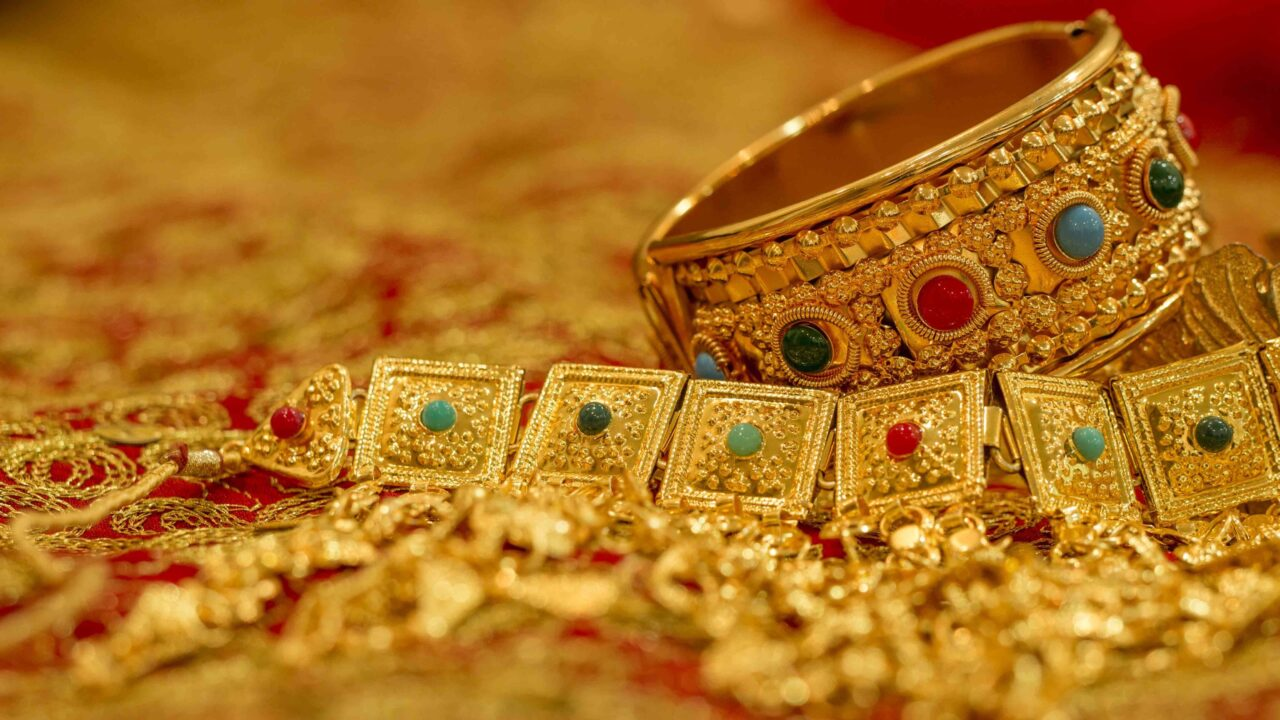
The state of Kerala, located along the southwestern Malabar Coast of India, is a land marked by its unique geography and culture. This distinctiveness stems from the blending of religion and ritual, royal patronage, and maritime trade that has continued for millennia. Together, these factors have made Kerala one of the regions with the strongest “gold culture” in India.
1. Religious and Ritual Significance
Gold occupies an exalted position within Hinduism and the ritual traditions of Kerala, where it is regarded not merely as a precious metal but as a sacred substance associated with divine blessings, purity, and prosperity. For centuries, gold has been extensively used as an offering to deities and as an essential element in the adornment of sacred images (murtis), reinforcing the close relationship between material wealth and spiritual devotion.
This religious significance is particularly evident in Kerala’s major temples, such as Sree Padmanabhaswamy Temple and Guruvayur Temple, both of which possess immense collections of gold accumulated through centuries of royal patronage and public donations. These treasures include elaborate necklaces, traditional coin chains (kasu mala), bangles, crowns, and specially crafted ornaments used to decorate the deities during daily rituals and major religious festivals.
Underlying these practices is a deeply rooted belief that gold embodies divine power and auspicious energy. As a result, the possession and donation of gold are widely associated with good fortune, social prestige, and spiritual merit. This enduring belief has played a crucial role in shaping Kerala’s identity as one of the regions with the strongest and most enduring “gold culture” in India.
2. Royal and Aristocratic Connections
The prominence of gold in Kerala was further strengthened through centuries of royal patronage and aristocratic traditions. Powerful dynasties, particularly the Cochin Royal Family and the Travancore Royal Family, played a significant role in supporting the development of goldsmithing and elevating gold to a central element of courtly culture. Through their patronage, highly skilled artisans were able to refine intricate techniques of jewelry making, producing ornaments that reflected both artistic excellence and social prestige.
Within royal ceremonies, gold served purposes that extended far beyond personal adornment. Elaborate ornaments, crowns, necklaces, and ceremonial regalia functioned as visible symbols of political authority and divine legitimacy. At the same time, rulers frequently dedicated gold objects as offerings to temples and deities, reinforcing the sacred relationship between kingship and religion. Such practices helped establish the idea that a king’s prosperity and legitimacy were inseparable from his ability to demonstrate devotion through acts of generosity and religious patronage.
Today, this historical legacy can be observed at the Hill Palace Museum, the former residence of the Cochin royal family and now the largest archaeological museum in Kerala. Its collections include gold jewelry, royal regalia, ceremonial objects, and artworks that illustrate the enduring role of gold in shaping Kerala’s political, religious, and cultural identity across generations.
3. Trade and Maritime Networks
Kerala’s strong association with gold was also shaped by its strategic position along the Indian Ocean maritime trade routes, which have connected the region to distant civilizations since antiquity. For more than two millennia, merchant vessels from Arabia, Persia, Rome, China, and later various European powers regularly visited Kerala’s ports to exchange valuable commodities such as spices, ivory, silk, and gold. Among these ports, the ancient harbor of Muziris emerged as one of the most important centers of international commerce, serving as a gateway between South Asia and the wider world.
These extensive maritime exchanges ensured a steady inflow of gold into Kerala and contributed significantly to the region’s economic prosperity. At the same time, sustained contact with foreign merchants exposed local goldsmiths to diverse artistic traditions and manufacturing techniques. Decorative elements inspired by Arab and Persian aesthetics, along with European methods of gemstone setting and metal craftsmanship, were gradually incorporated into Kerala’s jewelry-making practices, enriching the visual language of local ornamentation.
As gold became increasingly abundant within the regional economy, its significance expanded beyond commercial value. It evolved into a trusted store of wealth, a safeguard against economic uncertainty, and a powerful marker of social status. Over time, the accumulation and display of gold came to symbolize not only material prosperity but also familial prestige and cultural identity, reinforcing Kerala’s reputation as one of India’s most enduring centers of gold culture.
4. Social and Familial Roles
Gold occupies a central position in Kerala’s social and familial life, particularly in the context of marriage traditions, where it serves as a powerful expression of family honor, prosperity, and social standing. During wedding ceremonies, brides are traditionally adorned with substantial quantities of gold jewelry, including necklaces, bangles, earrings, waist belts, and other ceremonial ornaments. These adornments are not merely decorative; they represent the collective wealth, status, and reputation of the family, while also symbolizing blessings for a prosperous and secure future.
Beyond its ornamental significance, gold has long been regarded as a reliable form of savings and an important economic safeguard. In Kerala’s social structure, women have traditionally possessed the right to own and retain gold as personal property, giving it a practical role as a form of financial security that can be preserved, inherited, or mobilized during times of economic uncertainty. This tradition has contributed to the enduring perception of gold as both a valuable asset and a means of protecting household stability across generations.
Consequently, gold functions in Kerala as far more than an object of personal adornment. It has evolved into a form of “social and cultural capital” that embodies economic resilience, familial continuity, and collective identity. Through its transmission from one generation to the next, gold remains deeply intertwined with the social fabric of Kerala, reflecting the region’s enduring values of kinship, heritage, and cultural prestige.
Conclusion
Kerala is pivotal in the history of gold jewelry because it stands at the intersection of religious ritual, royal patronage, and maritime trade networks, all of which have elevated the status of gold beyond that of most other Indian regions. This convergence fostered unique local ornament styles and hereditary goldsmithing traditions that continue to exert influence today.
Origins and Historical Evolution

Image : The End of Early Indus Civilization – Easy Peasy All-in-One Homeschool
1. Beginnings in Ancient Civilizations
The history of gold in the Indian subcontinent can be traced back to the Indus–Sarasvati Civilization, one of the world’s earliest urban civilizations. Archaeological excavations have revealed a variety of gold objects, including beads, thin sheets, and delicate wires that were used for personal adornment and ritual activities. These discoveries demonstrate that gold was already highly valued, serving purposes that extended beyond decoration to encompass symbolic, spiritual, and economic dimensions of everyday life.
The sophistication of these artifacts also reflects the advanced metallurgical knowledge possessed by ancient craftsmen. Over time, techniques for extracting, shaping, and refining gold evolved from relatively simple methods into highly developed forms of craftsmanship, enabling artisans to produce increasingly intricate and durable ornaments. This technological progress laid the foundation for India’s long-standing reputation as one of the world’s great centers of gold artistry.
From these early beginnings, the use of gold gradually expanded throughout the Indian subcontinent, reaching different cultural regions through extensive networks of trade and cultural exchange. South India, in particular, became an important recipient and later a significant center of gold consumption and craftsmanship. These centuries of interaction helped establish gold as an enduring symbol of prosperity, social prestige, and religious devotion that would continue to shape Indian society for millennia.
2. South Indian Context before the Chola–Pandya Era
Long before the rise of the Chola and Pandya kingdoms, gold already occupied an important place in the societies of South India. Evidence from the Sangam Age (3rd century BCE–300 CE) reveals that gold and precious gemstones were deeply embedded in Tamil cultural life, serving as symbols of prosperity, social distinction, and sacred devotion. This early period witnessed the development of sophisticated traditions of ornamentation that would later influence the artistic heritage of southern India for centuries.
The significance of gold is extensively documented in Sangam literature, which frequently portrays its use in wedding ceremonies, royal adornment, and religious worship. Literary descriptions depict gold ornaments as essential expressions of status and honor, while also emphasizing their role in marking important stages of life and reinforcing social relationships. Gold was therefore understood not merely as a material possession but as an object carrying cultural, ceremonial, and spiritual meaning.
The prosperity that sustained these traditions was closely connected to maritime trade along the Malabar Coast. Through active commercial networks, South India received a continuous inflow of gold and precious stones from distant regions. Among the most important centers of exchange was the ancient port of Muziris, which served as a major gateway linking South India to the Greco–Roman world. Archaeological discoveries, particularly large hoards of Roman coins found in Kerala, provide compelling evidence of these extensive trade relationships and demonstrate how international commerce contributed to the accumulation of wealth that would later shape the region’s enduring gold culture.
3. The Golden Age of the Chola–Pandya Dynasties (9th–13th Century CE)
The Chola and Pandya kingdoms ushered in a golden age of artistic and cultural achievement in South India, elevating the craft of goldsmithing to unprecedented levels of sophistication. Between the ninth and thirteenth centuries CE, gold became increasingly prominent in both religious and social life, serving not only as a symbol of wealth and political power but also as an essential medium through which devotion and sacred authority were expressed. Royal patronage enabled highly skilled artisans to refine their techniques and produce works that blended exceptional craftsmanship with profound spiritual significance.
One of the most important developments of this period was the creation of elaborate gold ornaments specifically designed to adorn temple deities, particularly representations of Shiva, Parvati, and Vishnu. These ornaments were used during daily rituals, festivals, and ceremonial processions, transforming sacred images into radiant embodiments of divine presence. Through this practice, gold became inseparable from religious experience, reinforcing the intimate connection between artistic expression and spiritual devotion.
Over time, this tradition gave rise to the distinctive category known as Temple Jewellery—ornaments imbued with sacred meaning that were originally created for ritual use but were later adapted and replicated for royal courts and aristocratic families. As these designs moved beyond temple spaces, they became enduring symbols of prestige, preserving their religious associations while acquiring new social and cultural functions.
Artisans of the Chola period were particularly renowned for their emphasis on symmetry, meticulous detail, and sophisticated gemstone inlay techniques. Their creations frequently incorporated religious and natural motifs, including representations of deities, peacocks, leaves, and the iconic mango shape, each carrying symbolic meanings associated with fertility, prosperity, beauty, and divine protection. These aesthetic principles would profoundly influence South Indian jewelry traditions and continue to shape the visual identity of temple jewelry into the present day.
4. Continuity in Kerala and Local Dynasties
Situated adjacent to the historic centers of Tamil power, Kerala absorbed many artistic influences from the Chola–Pandya traditions while gradually developing distinctive local interpretations of its own. Through centuries of cultural interaction, religious exchange, and regional trade, Kerala adapted these established forms of gold craftsmanship to reflect its unique social and aesthetic traditions. As a result, the region cultivated a recognizable style of jewelry that retained elements of South Indian temple artistry while expressing a distinctly Keralan identity.
This evolution was strongly supported by local ruling dynasties, particularly the Cochin Royal Family and the Travancore Royal Family, both of which actively patronized skilled goldsmiths. Artisans were commissioned to create elaborate ornaments for royal ceremonies, state functions, and temple rituals, reinforcing the close relationship between political authority, religious devotion, and artistic production. Through this patronage, goldsmithing became an important vehicle for preserving cultural heritage and transmitting artistic knowledge across generations.
Over time, gold jewelry became deeply integrated into Kerala’s everyday social and ceremonial life. It assumed a central role in religious observances, marriage traditions, and a variety of cultural practices that continue to define the region today. Its influence also extended into the performing arts, where classical dance forms such as Kathakali and Mohiniyattam frequently incorporate reproductions of Temple Jewellery as part of their costumes. These ornaments not only enhance the visual grandeur of performances but also preserve the symbolic language of sacred adornment, allowing centuries-old artistic traditions to remain visible within contemporary cultural expression.
5. Trade and Cross-Cultural Exchange
From antiquity through the medieval period, Kerala occupied a strategic position within the maritime networks of the Indian Ocean, emerging as one of South Asia’s most important centers of international trade. Its location along the Malabar Coast enabled the region to establish enduring commercial connections with distant civilizations, transforming Kerala into a vibrant crossroads where merchants, commodities, and cultural ideas converged over many centuries.
Arab, Persian, and later European merchants regularly arrived at Kerala’s ports to exchange gold for highly sought-after spices, including pepper, camphor, and cinnamon. This continuous flow of commerce generated substantial wealth for the region and ensured a steady influx of precious metals that further strengthened Kerala’s longstanding association with gold. As a result, gold became deeply embedded in both the economic foundations and the cultural identity of local communities.
These sustained interactions also created opportunities for artistic exchange, allowing Kerala’s goldsmiths to absorb and reinterpret techniques from a wide range of traditions. Decorative elements inspired by Islamic geometric patterns, alongside European approaches to gemstone setting and metal craftsmanship, were gradually incorporated into local jewelry-making practices. Rather than simply adopting foreign designs, artisans skillfully integrated these influences into existing South Indian traditions, producing distinctive works that reflected Kerala’s role as a meeting point between diverse cultures.
Through this process of adaptation and synthesis, Kerala developed a unique visual language of gold craftsmanship that combined indigenous religious symbolism with international artistic influences. This fusion not only enriched the aesthetic quality of Kerala’s jewelry traditions but also reinforced the region’s historical identity as a dynamic center of cross-cultural exchange within the wider Indian Ocean world.
6. From Temple Jewellery to Family Symbolism
Over time, Temple Jewellery gradually evolved beyond its original sacred function and became an influential model for personal and familial adornment throughout Kerala. Ornaments that were once created exclusively for temple deities and ritual ceremonies were adapted for use in domestic and social contexts, allowing sacred aesthetics to become deeply embedded in everyday cultural life. Through this transformation, jewelry retained its religious symbolism while acquiring new meanings associated with family heritage and social identity.
Several iconic designs emerged as enduring expressions of this transition, including the kasu mala (coin necklace), maanga mala (mango-shaped necklace), traditional bangles, and jhumka earrings. These ornaments became widely recognized markers of prosperity and refinement, often worn during weddings, festivals, and other important life-cycle ceremonies. Their repeated presence across generations effectively turned them into a form of “social uniform,” visually communicating a family’s wealth, status, and cultural continuity within society.
As these traditions became more deeply established, the accumulation of gold assumed a significance that extended far beyond material value. Gold came to symbolize family honor, intergenerational inheritance, and collective identity, serving as a tangible representation of social standing and long-term security. In Kerala, the transmission of gold jewelry from one generation to the next continues to reinforce bonds of kinship and preserve cultural memory, demonstrating how objects of adornment can evolve into enduring expressions of heritage and belonging.
Conclusion
The history of gold in Kerala stretches back to antiquity and has been shaped by centuries of maritime trade, artistic patronage, and royal authority. Through continuous interactions with neighboring kingdoms and overseas trading partners, gold became deeply embedded in the region’s economic, religious, and cultural foundations.
The tradition of Temple Jewellery, which flourished during the Chola–Pandya period, was subsequently carried forward and adapted within Kerala. What began as sacred adornment for temple deities gradually evolved into an important social symbol, representing family prestige, prosperity, and cultural continuity across generations.
Kerala therefore presents a distinctive cultural landscape in which gold is far more than an economic commodity. It constitutes a living heritage that seamlessly intertwines religion, royal traditions, and kinship, reflecting the enduring relationship between material wealth and collective identity in Kerala society.
Goldsmith Communities — Caste, Profession, and Local Terminology

Image : Folktales of Kerala:The Resourceful Goldsmith - historified
1. The Viswakarma Network and the Caste System
In Kerala, traditional goldsmiths are generally associated with the Viswakarma community, a broad network of hereditary artisans often regarded in Hindu tradition as “universal craftsmen.” Rather than referring to a single occupation, the Viswakarma community encompasses several specialized branches of artisans whose skills have supported religious, architectural, and cultural life for centuries.
Among these groups, the Thattan are responsible for gold and silver craftsmanship, while the Kollan work as blacksmiths, the Aasari specialize in carpentry and woodcarving, the Moosari create bronze objects such as bells and deity statues, and the Thachan are known for temple architecture and traditional building techniques. Together, these artisan communities have formed an interconnected system in which knowledge and craftsmanship are passed down through generations.
This hereditary network has played a crucial role in preserving Kerala’s artistic traditions. Goldsmithing, in particular, has remained closely linked to religious rituals, royal patronage, and family customs, allowing the skills of the Viswakarma artisans to endure as an important part of Kerala’s cultural heritage.
2. Goldsmiths in Kerala: Thattan and Local Significance
In Kerala, traditional goldsmiths are known as Thattan (തട്ടന്), a specialized branch within the broader Viswakarma community. Historical records dating back to the medieval period clearly distinguish the Thattan from other artisan groups, such as the Kollan (blacksmiths) and the Moosari (bronze casters), highlighting their unique role as master craftsmen dedicated exclusively to precious metals.
The Thattan are particularly renowned for creating ritual and ceremonial jewelry that remains central to Kerala’s cultural life. Their work includes Temple Jewellery as well as traditional wedding ornaments such as the maanga mala (mango-shaped necklace), kasu mala (coin necklace), and oddiyanam (gold waistband), all of which carry deep symbolic meanings associated with prosperity, fertility, and family prestige.
Although the Thattan do not belong to the Brahmin priestly class, their profession has long been regarded as implicitly sacred. This status stems from the fact that the ornaments they create are used in temple rituals and marriage ceremonies—two of the most important sacred institutions in Kerala society. Through their craftsmanship, the Thattan have become not only artisans but also custodians of a cultural tradition that connects religion, family, and social identity across generations.
3. Terminology in the Indian Subcontinent
Across the Indian subcontinent, goldsmiths are known by various names that reflect regional languages and traditions. Common terms include Swarnakar—derived from the Sanskrit words swarna (gold) and kara (maker)—as well as Sunar in northern India and Soni in regions such as Gujarat and Rajasthan. Despite these differences in terminology, all refer to communities traditionally associated with the craft of goldsmithing.
In Kerala, however, goldsmiths maintain a distinct local identity and are known as Thattan rather than by these broader Indian terms. Their identity is closely connected to Kerala’s cultural traditions and the hereditary artisan structure of the Viswakarma community, reflecting a regional interpretation of craftsmanship that has developed over many centuries.
Historical studies also suggest that the Thattan possess lineage and kinship networks that are separate from those of goldsmith communities elsewhere in India. This distinction has helped preserve a unique cultural identity, allowing Kerala’s goldsmithing traditions to evolve independently while remaining deeply rooted in the region’s religious, social, and artistic heritage.
4. Inheritance and Family System
One of the defining characteristics of the Thattan community is the intergenerational transmission of knowledge within the family. Goldsmithing skills—including shaping, casting, engraving, and gemstone setting—have traditionally been passed down from father to son, ensuring the continuity of techniques that have been refined over centuries.
This apprenticeship extends beyond technical expertise to encompass cultural knowledge and symbolic traditions. Younger generations learn the meanings behind ceremonial jewelry designs, auspicious motifs, and the conventions associated with creating ornaments for temples and weddings. In this way, craftsmanship is preserved not only as a profession but also as a form of cultural inheritance.
The system has fostered a close-knit and highly disciplined artisan community that resembles a semi-guild structure. Members traditionally uphold shared ethical principles, including commitments to craftsmanship, authenticity, and the use of pure materials. These values have helped maintain public trust and have contributed to the enduring reputation of Kerala’s Thattan goldsmiths as custodians of both artistic excellence and cultural heritage.
5. Sacred and Social Dimensions
Transmission of Knowledge and Techniques (Hereditary Craft)

Image : Kerala craftsmen | Dustin Senger
1. General Characteristics of Hereditary Transmission
One of the defining characteristics of Kerala’s goldsmithing tradition is its hereditary mode of transmission, which has historically remained concentrated within the Thattan community. Rather than being taught through formal educational institutions or public training centers, knowledge is traditionally passed down within households and small family workshops, allowing skills to be preserved across generations.
This process of learning extends beyond technical instruction and is rooted in everyday participation within the family environment. Younger generations acquire practical experience through observation, repetition, and close guidance from senior craftsmen, gradually developing the expertise required to continue the profession.
Goldsmithing knowledge is also regarded as a valuable family asset. In addition to techniques such as shaping and casting, artisans safeguard specialized knowledge, including metal alloy compositions, polishing methods, and principles for selecting gemstones. These closely guarded practices are rarely shared outside the community, helping to preserve both the uniqueness of the craft and the cultural identity of Kerala’s traditional goldsmiths.
2. Apprenticeship System
The apprenticeship system among Kerala’s Thattan goldsmiths traditionally begins at an early age within the family environment. Young boys often start by assisting with simple tasks, such as preparing the fire, collecting and sweeping gold dust, or polishing finished pieces. These activities gradually familiarize them with the tools, materials, and discipline required for the profession.
As they reach adolescence, apprentices progress to more advanced techniques, including rolling gold sheets, shaping metal through hammering, and performing delicate soldering processes using heat. Training follows an experiential approach, allowing skills to develop progressively through hands-on practice under the close supervision of experienced family members.
Instruction is primarily transmitted through oral tradition rather than written manuals. Knowledge is passed on through demonstration, verbal guidance, and continuous repetition, with mastery achieved through years of observation and imitation. In some families, women also contribute to the craft, particularly in meticulous tasks such as gemstone setting and creating intricate decorative patterns. Nevertheless, due to longstanding social structures, the primary responsibility for goldsmithing has traditionally remained with male members of the household.
3. Techniques Passed Down
The hereditary transmission of goldsmithing in Kerala encompasses far more than the ability to produce jewelry. It involves a sophisticated body of technical knowledge that has been refined over generations, combining craftsmanship, artistic symbolism, and ritual traditions into a unified practice.
Among the most important techniques is lost-wax casting (cire-perdue), in which intricate designs are first sculpted in wax, coated with clay, and then fired so that the wax melts away before molten gold is poured into the mold. This method is widely used for creating Temple Jewellery and ritual objects, including ceremonial bangles and small crowns for deities. Artisans also employ chasing and repoussé techniques, carefully hammering patterns onto gold sheets to produce motifs such as lotus flowers, leaves, deities, and the iconic mango (maanga) design that characterizes Kerala jewelry.
Another essential skill is gemstone setting, particularly the placement of sapphires, rubies, emeralds, and zircon stones within gold ornaments. Techniques influenced by North Indian traditions, such as kundan and jadau, have been adapted to suit Kerala’s distinct aesthetic preferences. The process concludes with chiseling, polishing, and surface finishing, during which artisans apply specialized polishing compounds and traditional stone powders to achieve a durable, reflective finish. Together, these techniques represent a comprehensive system of inherited knowledge that preserves the unique identity of Kerala’s goldsmithing tradition.
4. Social Dimension of Knowledge Preservation
The preservation of goldsmithing knowledge within the Thattan community serves both practical and cultural purposes. Restricting access to outsiders has traditionally helped protect the economic stability of the community while safeguarding the uniqueness and authenticity of its artistic traditions. In this sense, craftsmanship is regarded as a collective inheritance rather than individual property.
Gold objects themselves are viewed as more than luxury possessions, as they are closely intertwined with religious rituals, temple ceremonies, and important family events. Because of this sacred association, many artisans consider their work a form of cultural responsibility and regard the preservation of purity, quality, and traditional methods as a sacred duty.
To maintain these standards, the community has historically upheld strong ethical principles. Goldsmiths who violate established norms—such as revealing family knowledge to outsiders or using impure materials—may face social sanctions, including loss of trust or exclusion from professional networks. These practices have helped preserve both the integrity of the craft and the cultural values that have sustained Kerala’s goldsmithing tradition for generations.
5. Modern Changes
Since the nineteenth and twentieth centuries, the expansion of global trade and the growth of the jewelry industry have gradually transformed Kerala’s traditional goldsmithing practices. Knowledge that was once confined to hereditary artisan communities has become more accessible, allowing Kerala’s craftsmanship to reach broader national and international markets.
Today, formal training institutions and professional jewelry programs coexist alongside traditional methods of learning. Nevertheless, many Thattan families continue to believe that true mastery cannot be acquired solely through classroom instruction, but must be cultivated through years of practice within the family lineage, where technical skills are inseparable from cultural values and inherited traditions.
As a result, Kerala now operates through a dual system of production. On one side, an industrial jewelry sector produces ornaments on a large scale to meet commercial demand; on the other, hereditary family-based workshops continue to preserve traditional techniques and artisanal knowledge. This coexistence allows Kerala to adapt to modern economic realities while maintaining a living connection to its centuries-old goldsmithing heritage.
Patterns and Symbols of Kerala Jewelry
1. Kasu Mala (Coin Necklace)

Image : Antique Laksmi kasu mala - 7079 - Krisa Jewellery
The Kasu Mala (കാസു മാല) is one of Kerala’s most iconic traditional ornaments, consisting of a series of small gold discs or coins linked together to form a necklace. The word kasu means “coin,” reflecting its original design and its longstanding association with wealth and abundance.
Traditionally, the Kasu Mala symbolizes prosperity, social prestige, and familial honor. It is especially important in wedding ceremonies, where it signifies a family’s ability to provide gold as both a cultural inheritance and a form of economic security for the bride. For this reason, it has become a powerful expression of status and intergenerational continuity within Kerala society.
The necklace often features engraved motifs, including representations of Goddess Lakshmi or geometric patterns associated with good fortune and divine blessings. Today, the Kasu Mala remains an essential component of a Kerala bride’s jewelry ensemble and continues to be regarded as one of the most important and recognizable symbols of Kerala’s gold heritage.
2. Maanga Mala (Mango Motif Necklace)

Image : shopzters.com/blogs/jewellery-and-accessories/these-maanga-maalais-are-absolutely-irresistible
The Maanga Mala is a traditional South Indian necklace distinguished by its mango-shaped motifs, inspired by the curved form of the mango fruit, which resembles a teardrop or a flame. This design has long been an important decorative element in South Indian art and is especially prominent in Kerala’s jewelry traditions.
The mango motif symbolizes fertility, continuity of life, and the preservation of family lineage, making it particularly meaningful in ceremonial contexts. As a result, the Maanga Mala is widely used in both Temple Jewellery and bridal ornaments, where it represents blessings for prosperity, family continuity, and a harmonious future.
In Kerala, the design is sometimes combined with the Kasu Mala to create the Lakshmi–Maanga Mala, a necklace that unites two powerful symbols: wealth and fertility. This combination reflects the cultural belief that material prosperity and the continuation of future generations are inseparable elements of a prosperous family life.
3. Temple Jewelry Forms

Image : Gold Haram – SRI SHANKARLAL JEWELLERS
Many of Kerala’s traditional ornaments originated as adornments for temple deities before gradually becoming part of royal ceremonies, wedding traditions, and classical performing arts. Today, these designs remain closely associated with dance forms such as Kathakali and Mohiniyattam, preserving their sacred symbolism within contemporary cultural expression.
Among the most recognizable forms is the Choker, a short necklace that features deity figures or auspicious motifs and symbolizes elegance and divine protection. The Haram, a longer necklace, often incorporates kasu (coin) patterns or large decorative pendants, emphasizing prosperity and ceremonial grandeur. Another iconic ornament is the Jhumka, a bell-shaped earring whose gentle movement is traditionally associated with beauty, grace, and sacred femininity.
Other important pieces include the Oddiyanam, a gold waist belt worn by both deities and brides, symbolizing stability and the control of life energy (shakti), and the Vanki, a V-shaped armlet decorated with deity or floral motifs that is traditionally believed to provide protection and blessings. Together, these ornaments illustrate how Kerala’s Temple Jewellery continues to bridge the worlds of religion, performance, and social tradition.
4. Other Key Motifs and Symbols

Image : Pure 92.5 Silver Ornate Temple Jewellery Pendant with Lakshmi Motif, W – Shobitam India
Kerala’s traditional jewelry is distinguished not only by its craftsmanship but also by the rich symbolic meanings embedded in its decorative motifs. These designs are closely linked to Hindu beliefs and are intended to convey blessings, protection, and prosperity to the wearer.
Among the most common motifs is Goddess Lakshmi, whose image frequently appears on kasu mala coins and oddiyanam waist belts as a symbol of wealth and abundance. The peacock is another important motif, representing elegance, beauty, and auspiciousness, while the lotus symbolizes purity, spiritual renewal, and rebirth. Both are commonly incorporated into bangles, earrings, pendants, and armlets.
Other traditional symbols include the Makara, a mythical creature combining the features of a crocodile and a fish, which is believed to bring protection and good fortune. The Navaratna tradition, meanwhile, involves setting nine different gemstones that correspond to the nine celestial bodies of Hindu astrology. These gemstone arrangements are often worn as protective talismans, reflecting the longstanding relationship between jewelry, spirituality, and cosmological beliefs in Kerala’s cultural traditions.
5. Presence in Research and Museums
Kerala’s traditional gold ornaments continue to be widely recognized in historical research, museum collections, and the performing arts, reflecting their enduring cultural significance. Local historical studies, including Keralacharithram (History of Kerala) and ethnographic research on the Thattan community, frequently identify these jewelry forms as essential elements of Kerala’s artistic and social heritage.
This legacy is preserved in museums such as Hill Palace Museum and Napier Museum, where collections of gold ornaments are displayed alongside royal artifacts associated with the Cochin and Travancore dynasties. These exhibitions illustrate the close relationship between gold craftsmanship, royal patronage, and religious traditions throughout Kerala’s history.
The tradition also remains visible in the performing arts. Institutions such as Kerala Kalamandalam continue to incorporate traditional Temple Jewellery into the costumes of classical performers, ensuring that these centuries-old designs remain an active and living component of Kerala’s cultural identity rather than solely historical artifacts preserved in museums.
Museum Example — Hill Palace Museum, Thripunithura (Case Study)
Hill Palace Museum (Tripunithura, Kochi) is one of the key repositories of royal and ritual jewelry in Kerala. The collection includes court jewelry, temple adornments, and ethnographic objects that illustrate the evolution of local ornamentation patterns. Records and documentation from the Centre for Heritage Studies identify Hill Palace as an important resource for the study of traditional jewelry forms in Kerala.
Ethnographic research and museum reports have compiled images and descriptions of representative pieces (such as Kasu malas, temple necklaces, and waist belts), providing crucial evidence for tracking changes in jewelry styles over the past century.
Key Fact: Hill Palace houses a Kerala jewelry collection frequently cited in scholarly studies.
Impact of the Modern Era — Trade, Industry, and “Deskilling”

1. Gold Economy in Kerala: From Ritual to Global Market
In modern Kerala, gold has evolved far beyond its traditional role as a ritual object or ceremonial ornament. It has become a form of household wealth and long-term savings, often described as a “family bank” that provides financial security across generations. As a result, Kerala has developed one of the highest levels of gold ownership in India, reflecting the deep integration of gold into everyday economic life.
This transformation accelerated from the 1970s onward, when large numbers of Keralites migrated to the Middle East for employment. Rising household incomes and remittances sent home by migrant workers significantly increased the purchasing power of families, leading to a sharp growth in demand for gold, particularly for weddings, investments, and family inheritance.
Consequently, Kerala’s gold economy shifted from a traditional artisan-based system toward a modern market-oriented industry. What was once dominated by small hereditary workshops gradually expanded into a large commercial sector connected to national and global trade networks, reshaping the relationship between craftsmanship, consumption, and cultural tradition in contemporary Kerala.
2. Factory Production and Imports
Traditionally, Kerala’s Thattan goldsmiths produced each ornament by hand, employing highly specialized techniques such as lost-wax casting, repoussé, engraving, and gemstone setting. Every piece required considerable time, precision, and artistic knowledge, making jewelry production a deeply personal and culturally significant process.
Today, however, the jewelry industry has become increasingly industrialized. Large retailers and commercial networks rely on machinery, standardized molds, and ready-made products imported from regions such as Tamil Nadu, Maharashtra, and even Dubai. This shift has enabled faster production and greater accessibility but has also reduced the demand for labor-intensive handcrafted work.
As a consequence, many traditional Thattan families have experienced a decline in their social and economic position. Some have transitioned into lower-wage factory employment, while others have gradually left the profession altogether. This transformation illustrates the growing tension between industrial efficiency and the preservation of Kerala’s hereditary goldsmithing traditions.
3. The Deskilling Phenomenon
In studies of labor and craftsmanship in India, the term deskilling refers to the gradual loss of traditional skills as modern industrial production replaces labor-intensive artisanal practices. Techniques that once required years of training and specialized knowledge are increasingly overlooked because they are no longer essential to large-scale manufacturing processes.
This transformation has also weakened the professional identity of traditional goldsmiths. Craftsmen who were once highly respected as master artisans and cultural custodians have, in many cases, become wage workers within an industrial system, where efficiency and mass production often take precedence over individual craftsmanship.
At the same time, the longstanding relationship between family, lineage, and craft has begun to erode. Many younger members of goldsmith families no longer pursue the profession, instead choosing careers in the service sector, general manufacturing, or overseas employment. These changes reflect a broader social transition in Kerala, where economic opportunities are expanding, but the continuity of hereditary goldsmithing traditions faces increasing challenges.
4. Changes in Viswakarma/Thattan Identity
5. Socio-Cultural Consequences
6. Academic Analysis and Conservation Policy
Conclusion
Although Kerala continues to be recognized as India’s “state of gold” because of its exceptionally high levels of gold consumption, its traditional goldsmithing heritage is facing a period of significant transition. The expansion of industrial production and global trade has gradually reduced the role of hereditary artisans, placing centuries-old practices under increasing pressure.
The phenomenon of deskilling extends beyond the loss of technical expertise. It also threatens the long-standing relationship between caste, occupation, and cultural identity that has historically defined the Viswakarma community and the Thattan goldsmiths. As fewer younger generations continue the profession, the continuity of inherited knowledge and social traditions becomes increasingly uncertain.
Preserving these skills is therefore not only an issue of safeguarding artistic craftsmanship but also an important concern for the creative economy and the protection of intangible cultural heritage (ICH). Ensuring that these traditions remain living practices, rather than solely historical memories, will be essential to maintaining Kerala’s unique cultural identity for future generations.
Bibliography (Key Documents / PDF Articles and Academic Sources)
The following are the academic documents and reports I have referenced. You can click to read/download them (links are provided through citations attached in this system):
-
“VISWAKARMA ARTISANS AND THEIR TRADITIONAL CRAFTSMANSHIP IN KERALA” — Article (PDF) discussing the structure of the Viswakarma community and the role of Thattan (goldsmiths). int-jecse.net
-
“A Case of Hill Palace Museum” (JETIR paper / report on Hill Palace) — Report/article describing the Hill Palace collection and the role of the museum. Jetir
-
“Under the Curse of Gold: Kerala’s Gold Boom and the Exit of Vishwakarma Goldsmiths” — Academic article/essay (Academia) analyzing deskilling and occupational changes among goldsmiths in Kerala. Academia
-
“Ethnic Jewellery of Kerala” (report / Academia) — Article summarizing various local jewelry styles and linking them to museum sources (e.g., Hill Palace). Academia
-
Historical articles/summaries on Temple Jewellery and Artistic Evolution — Multiple PDFs/articles, including works describing origins during the Chola–Pandya period. iisjoa.org+1
-
Policy / State Museum Reports of Kerala (work study / Department documents) — Information on Hill Palace Museum and the operations of heritage centers. Kerala Government Document Portal



 Line
Line
 WhatsApp