
The static image captures form. Movement reveals behavior — and without it the story stays incomplete.
Real life, real movement, real context
A world designed for the image
On the runway, jewelry is never accidental. It is placed with precision, scaled for visibility, and designed to exist within a single, controlled moment. Under bright lights and fixed angles, every detail is calibrated to be seen from a distance and captured in an image. The purpose is not wearability, but impact.

In this environment, jewelry becomes part of a visual language, one that is deliberate, composed, and often exaggerated. Pieces are chosen not only for what they are, but for how they complete a narrative. But the runway is a constructed space. And outside of it, everything begins to change.
When the image dissolves
Once jewelry leaves the runway, it is no longer held in place by intention alone. It moves with the body, shifts with posture, responds to gestures, and settles differently over time. A necklace that appears perfectly aligned in a photograph rarely remains that way throughout the day. It drifts slightly, caught between movement and gravity, becoming less composed and more lived. This is where jewelry begins to separate from image and return to function.
It is no longer something observed at a distance, but something experienced, worn through moments that are unplanned, unfiltered, and constantly changing.
From statement to presence
On the runway, scale is often necessary. Jewelry must compete with garments, lighting, and distance. It is designed to stand out. In real life, that same logic does not always apply.
When Zendaya appears on the red carpet, her jewelry is often architectural, structured pieces from houses like Bulgari that are carefully placed to align with the silhouette of the garment. The effect is precise, almost sculptural. But outside of these moments, her approach shifts. In candid appearances, the jewelry becomes quieter. A single chain, a pair of small hoops, or a ring worn without emphasis replaces the complexity of high jewelry. The intention is no longer to complete a visual statement, but to exist naturally within it.
Nothing is lost in this transition. Only the function changes. Jewelry moves from statement to presence: from something designed to be seen, to something designed to be lived with. It is the logic behind an everyday wear collection.
Rewriting the rules of context

If some choose to simplify, others choose to reinterpret. Rihanna rarely separates high jewelry from everyday life. Pieces that might traditionally be reserved for formal settings, layered chains, bold earrings, stacked rings, appear in her off-duty looks as naturally as they would on a stage. Walking through the city or arriving at an event, the distinction between “runway” and “real life” becomes less defined. Jewelry is not adjusted to fit the setting, the setting adapts to the jewelry. This approach challenges a long-standing assumption: that certain pieces belong only to certain contexts.
Instead, it suggests that context is flexible and that meaning is shaped not by rules, but by how something is worn.
Precision under pressure
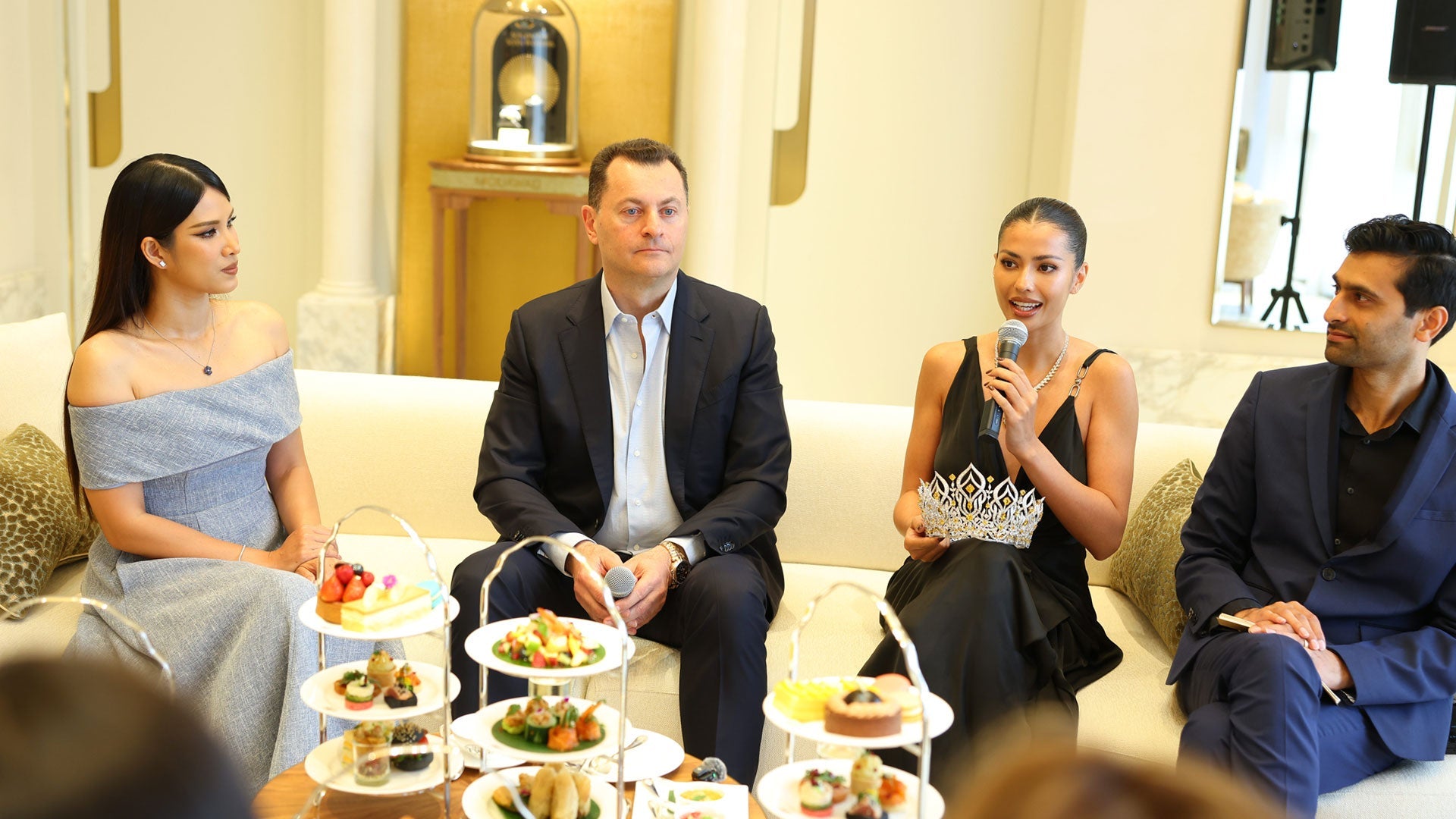
In pageant environments, the relationship between jewelry and image remains highly structured. When Anntonia Porsild appears on stage, every detail is carefully considered. Earrings are selected to elongate the neckline, necklaces are balanced against the form of the gown, and stones are chosen for how they respond to intense lighting. Here, jewelry must perform under pressure. It must be visible, symmetrical, and aligned with expectation.
But even within this controlled setting, movement introduces variation. A slight turn of the head, a shift in posture, or a change in light can alter how a piece is perceived. What appears perfectly composed in a still image reveals subtle complexity in motion. The illusion of perfection begins to soften.
Movement as the missing layer
Off the runway, jewelry is never still. It moves with breath, with gesture, with the rhythm of the body. Earrings swing slightly as someone turns their head. A bracelet shifts with each movement of the hand. A necklace catches light differently depending on how it rests. These changes are subtle, but they are constant and they reshape perception.
A piece that appears bold in a still image may feel understated in motion. Something minimal may reveal unexpected depth as it interacts with light and movement. The static image captures form but movement reveals behavior. Without it, the story remains incomplete.
The influence of environment
Outside of controlled environments, jewelry responds to more than just the body. Light changes throughout the day. Surfaces reflect differently depending on surroundings. Air, temperature, and movement in space all influence how a piece is experienced.
A pearl worn near the ocean carries a softness that cannot be replicated under artificial light. Gold takes on warmth outdoors, shifting in tone as the sun moves. Stones reveal depth gradually, depending on how light reaches them.
These are not details that can be staged. They belong to real life.
From object to experience
When jewelry leaves the runway, it is no longer defined by composition alone. It becomes part of something continuous, worn across time, shaped by movement, and influenced by context. The focus shifts away from perfection and toward interaction. It is not only about how a piece looks, but how it behaves.
How it settles. How it moves. How it becomes familiar. In this transition, jewelry stops being an object to observe and becomes something to experience.
The runway will always define direction. It will continue to shape how jewelry is introduced, styled, and imagined. But it does not define how jewelry lives. Because beyond the controlled image, beyond the fixed moment, there is another reality, one where jewelry moves, adapts, and exists in ways that cannot be fully captured. And it is only there, outside the runway, in real life, real movement, real context, that jewelry becomes complete.
Related reading: From ceremony to street and When jewelry becomes the headline.





 Line
Line
 WhatsApp